Uridine diphosphate: Difference between revisions
CSV import |
CSV import |
||
| Line 25: | Line 25: | ||
__NOINDEX__ | __NOINDEX__ | ||
{{No image}} | {{No image}} | ||
<gallery> | |||
File:Uridine_diphosphate_anion_3D_ball.png|Uridine diphosphate anion 3D ball | |||
</gallery> | |||
Revision as of 00:36, 27 February 2025
Uridine diphosphate (UDP) is a nucleotide that plays a significant role in the metabolism of glycogen and is a precursor of glycosylation reactions in cells. It is a member of the group of nucleoside diphosphates, which are molecules that contain a nucleoside (a nitrogenous base linked to a sugar) and two phosphate groups.
Structure
UDP consists of the pyrimidine base uracil linked to the 1' carbon of the ribose sugar, and a diphosphate group attached to the 5' carbon of the ribose. The diphosphate group is composed of two phosphate units, connected by an energy-rich anhydride bond.
Function
UDP is involved in a variety of cellular functions. It serves as a carrier of glucose in glycogen synthesis, where it is converted into UDP-glucose by the enzyme UDP-glucose pyrophosphorylase. This activated form of glucose is then used by glycogen synthase to add glucose units to the growing glycogen molecule.
In addition to its role in glycogen metabolism, UDP is also a precursor for the synthesis of glycoproteins and glycolipids. In these reactions, UDP donates sugar moieties that are added to proteins and lipids, respectively, in a process known as glycosylation.
Biosynthesis
UDP is synthesized in the cell from uridine monophosphate (UMP) through a two-step process. First, UMP is phosphorylated to uridine triphosphate (UTP) by the enzyme uridine monophosphate kinase. Then, UTP is converted to UDP by the action of nucleoside diphosphate kinase, which catalyzes the transfer of a phosphate group from adenosine triphosphate (ATP) to UTP.
See also
.svg)
This article is a biochemistry stub. You can help WikiMD by expanding it!
-
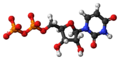 Uridine diphosphate anion 3D ball

