Argasidae: Difference between revisions
CSV import |
CSV import |
||
| Line 48: | Line 48: | ||
[[Category:Medical Entomology]] | [[Category:Medical Entomology]] | ||
{{No image}} | {{No image}} | ||
<gallery> | |||
File:Otobius_megnini.jpg|Otobius megnini | |||
</gallery> | |||
Revision as of 00:34, 27 February 2025
Argasidae
The Argasidae family, commonly known as the soft ticks, is a group of blood-feeding ectoparasites that primarily infest birds and mammals. Unlike the hard ticks of the Ixodidae family, Argasidae ticks lack a scutum, or hard shield, which gives them a more leathery appearance. This article provides an overview of their taxonomy, morphology, life cycle, and medical significance.
Taxonomy
The Argasidae family is divided into several genera, with the most notable being Argas, Ornithodoros, and Otobius. These genera encompass numerous species, each adapted to specific hosts and environments.
Genera
- Argas - Known for infesting birds, these ticks are often found in nests and roosting sites.
- Ornithodoros - This genus includes species that are vectors for various pathogens, including the agents of tick-borne relapsing fever.
- Otobius - Notable for the spinose ear tick, Otobius megnini, which primarily infests livestock.
Morphology
Argasidae ticks are characterized by their soft, flexible bodies. They lack the hard dorsal shield found in hard ticks. Their mouthparts are located on the underside of the body, making them less visible from above. This family exhibits sexual dimorphism, with females generally larger than males.
Life Cycle
The life cycle of Argasidae ticks includes the egg, larva, nymph, and adult stages. Unlike hard ticks, soft ticks can undergo multiple nymphal stages. They are capable of feeding multiple times during their life cycle, which can span several years.
Feeding Behavior
Soft ticks are nocturnal feeders, often taking refuge in cracks and crevices during the day. They are capable of rapid feeding, often completing a blood meal in less than an hour. This behavior contrasts with the prolonged feeding of hard ticks.
Medical Significance
Argasidae ticks are vectors for several diseases, most notably tick-borne relapsing fever, caused by Borrelia species. They can also cause tick paralysis and are known to induce allergic reactions in some individuals.
Tick-borne Relapsing Fever
This disease is characterized by recurring episodes of fever, headache, muscle and joint aches, and nausea. It is transmitted to humans through the bite of infected Ornithodoros ticks.
Control and Prevention
Controlling Argasidae populations involves habitat management, such as removing nesting materials and sealing entry points to buildings. Personal protective measures include the use of insect repellents and wearing protective clothing.
Conclusion
The Argasidae family plays a significant role in the ecology of tick-borne diseases. Understanding their biology and behavior is crucial for developing effective control strategies and preventing disease transmission.
References
- Centers for Disease Control and Prevention (CDC) - Tick-borne Diseases
- World Health Organization (WHO) - Vector-borne Diseases
-
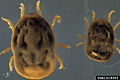 Otobius megnini

