May wine: Difference between revisions
CSV import |
CSV import |
||
| Line 22: | Line 22: | ||
{{Germany-stub}} | {{Germany-stub}} | ||
{{wine-stub}} | {{wine-stub}} | ||
<gallery> | |||
File:Maibowle_in_Dresden.jpg|Maibowle in Dresden | |||
File:Waldmeister.jpg|Waldmeister | |||
</gallery> | |||
Latest revision as of 00:23, 27 February 2025
May Wine is a traditional German beverage, often consumed as part of spring celebrations. It is a type of punch made from white wine, sweet woodruff, and often strawberries or other fresh fruit.
History[edit]
May Wine, also known as Maiwein in German, has a long history in Germany and other parts of Europe. It is traditionally consumed during the Walpurgis Night and May Day celebrations. The use of sweet woodruff as a flavoring comes from its traditional use in herbal medicine, where it was believed to have various health benefits.
Preparation[edit]
The preparation of May Wine involves steeping fresh sweet woodruff in white wine, typically a dry Riesling. The woodruff is usually wrapped in a cheesecloth or placed in a tea infuser to prevent the leaves from mixing with the wine. After steeping for several hours, the woodruff is removed and the wine is chilled. Before serving, fresh fruit such as strawberries or raspberries is added. Some variations of the recipe also include the addition of a sparkling wine or champagne.
Cultural Significance[edit]
May Wine is deeply tied to the celebration of spring in Germany. The sweet woodruff used in its preparation is a springtime herb, and the beverage itself is often associated with the renewal and vitality of the season. It is commonly served at garden parties and other outdoor gatherings during the spring months.
See Also[edit]


-
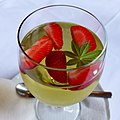 Maibowle in Dresden
 -
 Waldmeister


