Middle lamella: Difference between revisions
CSV import |
CSV import |
||
| Line 24: | Line 24: | ||
{{botany-stub}} | {{botany-stub}} | ||
== Middle lamella == | |||
<gallery> | |||
File:Plant_cell_wall_diagram-en.svg|Plant cell wall diagram | |||
File:Plant_Cell_Wall.png|Plant Cell Wall | |||
</gallery> | |||
Latest revision as of 21:04, 25 February 2025
Middle Lamella
The middle lamella is a thin layer rich in pectins that cements together the primary walls of adjacent plant cells. It is the first layer formed during cell division, laying the foundation for the construction of the cell wall that will ultimately define the shape and structure of the cell. The middle lamella is crucial for the integrity and cohesion of plant tissues, playing a significant role in the development and growth of plants.
Composition and Structure[edit]
The middle lamella is primarily composed of pectic substances, which are complex polysaccharides rich in galacturonic acid. These substances are highly hydrophilic, allowing them to retain water and contribute to the flexibility and support of plant tissues. The presence of calcium ions (Ca^2+) and magnesium ions (Mg^2+) in the middle lamella helps in cross-linking pectic substances, further strengthening the bond between adjacent cells.
Function[edit]
The primary function of the middle lamella is to glue adjacent plant cells together, providing structural integrity to the plant. By cementing cells, it helps in maintaining the shape and rigidity of plant tissues and organs. This is particularly important in non-woody parts of the plant, where rigidity is essential for maintaining posture and resistance against physical stresses.
In addition to its structural role, the middle lamella also plays a part in plant defense. The composition of the middle lamella can change in response to pathogen attack, strengthening the cell walls and making it more difficult for pathogens to penetrate.
Development[edit]
During cytokinesis in plant cell division, the middle lamella is the first structure to form between dividing cells. It originates from the cell plate, which gradually develops into the middle lamella and subsequently allows for the formation of the primary cell wall on either side of it. The development and maintenance of the middle lamella are crucial for the proper separation of daughter cells and the formation of new cell walls.
Significance in Plant Processing[edit]
The properties of the middle lamella are of significant interest in the processing of plant-based foods. The breakdown of pectic substances in the middle lamella, through the use of enzymes like pectinase, is a common practice in the food industry to soften plant tissues in products like jams, jellies, and canned fruits.
Research and Applications[edit]
Research into the middle lamella has implications for understanding plant growth, development, and response to environmental stresses. It also has potential applications in bioengineering and the development of plant-based materials with specific mechanical properties.

Middle lamella[edit]
-
 Plant cell wall diagram
 -
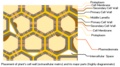 Plant Cell Wall


