Aguapanela: Difference between revisions
CSV import Tags: mobile edit mobile web edit |
CSV import |
||
| Line 22: | Line 22: | ||
[[Category:Non-alcoholic drinks]] | [[Category:Non-alcoholic drinks]] | ||
{{food-stub}} | {{food-stub}} | ||
== Aguapanela == | |||
<gallery> | |||
File:Agua_Panela_con_Queso_Fresco_at_La_Puerta_Falsa_(5617496209).jpg|Agua Panela con Queso Fresco | |||
File:panela.JPG|Panela | |||
</gallery> | |||
Latest revision as of 11:45, 25 February 2025

Aguapanela or Agua de Panela is a traditional South American beverage, particularly popular in Colombia and Venezuela. It is made by dissolving unrefined sugar cane juice, known as panela, in water and is served either hot or cold. Often considered a staple in the diet of many South American countries, aguapanela is not only a drink but also a cultural symbol, embodying the simplicity and warmth of rural life.
Preparation[edit]
The preparation of aguapanela is straightforward and involves dissolving blocks or granules of panela in boiling water. The panela is a solid form of pure cane sugar, which is traditionally made by boiling and evaporating sugarcane juice. Once the panela is fully dissolved, the beverage can be served in a variety of ways. It is commonly consumed hot, especially in the morning or on cold days, but can also be enjoyed cold, often with a squeeze of lime juice to add a refreshing acidity.
Cultural Significance[edit]
In countries like Colombia, aguapanela holds a place of affection in the hearts of many and is more than just a sweet drink. It is associated with home and comfort, often consumed to warm up during the rainy season or as a traditional remedy for the common cold. In rural areas, it is a symbol of hospitality, offered to guests upon arrival. Aguapanela also plays a role in social and family gatherings, serving as a simple yet cherished beverage.
Health Benefits[edit]
Aguapanela is touted for its health benefits, primarily due to the nutritional content of panela. Unlike refined sugar, panela retains vitamins and minerals from the sugarcane juice, including vitamins A, B, C, D, and E, as well as minerals like calcium, iron, and magnesium. It is believed to provide energy, aid in digestion, and help with hydration. However, like any sugary drink, it should be consumed in moderation.
Variations[edit]
While the basic recipe for aguapanela is simple, there are several variations. One popular version is aguapanela con limón, which includes the addition of lime juice. Another is aguapanela con leche, where milk is used instead of water, creating a richer, creamier drink. During colder months, aguapanela is often served with a dash of cinnamon or cloves for added warmth and flavor.
Economic Impact[edit]
The production of panela is an important economic activity in many rural areas of South America, providing a livelihood for thousands of families. The tradition of panela production is passed down through generations, and its continued demand, partly due to the popularity of aguapanela, supports rural economies.
Conclusion[edit]
Aguapanela embodies the essence of South American hospitality and tradition. Its simplicity, nutritional benefits, and versatility make it a beloved beverage. As a symbol of cultural identity and a testament to the region's agricultural practices, aguapanela continues to be cherished by people across South America and beyond.

Aguapanela[edit]
-
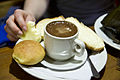 Agua Panela con Queso Fresco
 -
 Panela
.jpg)
