Dekopon: Difference between revisions
CSV import |
CSV import |
||
| Line 28: | Line 28: | ||
<gallery> | <gallery> | ||
File:Dekopon.jpg | File:Dekopon.jpg | ||
</gallery> | |||
<gallery> | |||
File:不知火_果実.jpg|Shiranui Fruit | |||
File:Dekopon.jpg|Dekopon | |||
</gallery> | </gallery> | ||
Revision as of 11:45, 25 February 2025
Dekopon is a seedless and sweet variety of mandarin orange. It is a hybrid between Kiyomi and ponkan (Citrus reticulata), first developed in Japan in 1972. Originally a brand name, "Dekopon" has become a genericized trademark and it is used to refer to all brands of the fruit; it is called hallabong in Korea.
History
The Dekopon was first developed in 1972 in Japan by the National Institute of Fruit Tree Science. However, it was not released to the market until 1991 due to concerns about its distinctive bump on the top of the fruit, which was thought to be unappealing to consumers. Despite initial concerns, the Dekopon has become one of the most popular citrus fruits in Japan.
Characteristics
The Dekopon is known for its sweet flavor which is much stronger than that of an orange. It is also larger and heavier than most mandarin varieties. The skin is thick and easy to peel, and the fruit has a distinctive bump on the top. The Dekopon is seedless and has a high vitamin C content.
Cultivation
Dekopon trees are evergreen, with glossy, dark green leaves. They prefer a sunny location and well-drained soil. The trees are usually grown from cuttings and start bearing fruit in 3 to 6 years. The fruit is typically harvested in winter.
Uses
Dekopon is primarily eaten fresh, but it can also be used in salads, desserts, and beverages. Its juice is very sweet and is often used in cocktails and other drinks.
See also


Dekopon

-
 Shiranui Fruit
 -
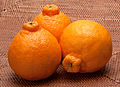 Dekopon

