Squid as food: Difference between revisions
CSV import |
CSV import |
||
| Line 39: | Line 39: | ||
[[Category:Japanese cuisine]] | [[Category:Japanese cuisine]] | ||
[[Category:Mediterranean cuisine]] | [[Category:Mediterranean cuisine]] | ||
<gallery> | |||
File:Babbo-_Squid_Ink_pasta_with_green_chilis,_rock_shrimp_and_guanciale.jpg|Squid Ink pasta with green chilis, rock shrimp, and guanciale | |||
File:Lipari-Calmars.jpg|Lipari Calmars | |||
File:Fried_calamari_in_Limnionas,_Kos,_Greece_(5654208438).jpg|Fried calamari in Limnionas, Kos, Greece | |||
File:Drying_squid.jpg|Drying squid | |||
File:Calamares_tapas.jpg|Calamares tapas | |||
File:Geso_karaage_by_Atari,_Gracinha_%26_Marco.jpg|Geso karaage by Atari, Gracinha & Marco | |||
File:Puntillitas.jpg|Puntillitas | |||
File:Rabas_de_calamar.jpg|Rabas de calamar | |||
</gallery> | |||
Latest revision as of 11:25, 25 February 2025
An overview of squid as a culinary ingredient
Squid as food refers to the culinary use of various species of squid, a type of cephalopod mollusk. Squid is a popular ingredient in many cuisines around the world, known for its tender texture and mild flavor. It is often prepared in a variety of ways, including grilling, frying, and stewing.
Culinary Uses[edit]
Squid is a versatile ingredient that can be used in a wide range of dishes. It is commonly found in Mediterranean cuisine, Japanese cuisine, and Korean cuisine, among others.
Preparation Methods[edit]
Squid can be prepared in several ways:
- Grilled Squid: Often marinated in olive oil, lemon juice, and herbs, then grilled over an open flame. This method is popular in Mediterranean countries.
- Fried Squid: Known as calamari when battered and deep-fried, this preparation is a popular appetizer in many Western countries.
- Stewed Squid: Squid can be slow-cooked in a tomato-based sauce, often with vegetables and spices, to create a rich stew.
- Raw Squid: In Japanese cuisine, squid is often served raw as sashimi or used in sushi.
Nutritional Value[edit]
Squid is a low-calorie source of protein and contains essential nutrients such as vitamin B12, zinc, and selenium. It is also a good source of omega-3 fatty acids, which are beneficial for heart health.
Cultural Significance[edit]
Squid holds cultural significance in various regions:
- In Italy, squid is a staple in coastal regions and is often included in seafood pasta dishes.
- In Japan, squid is a common ingredient in takoyaki and okonomiyaki, as well as being enjoyed as dried snacks.
- In Korea, squid is used in dishes such as ojingeo bokkeum, a spicy stir-fried squid dish.
Sustainability and Fishing[edit]
Squid populations are generally considered to be sustainable due to their rapid growth and short life cycles. However, overfishing and environmental changes can impact local populations. Sustainable fishing practices are encouraged to maintain healthy squid stocks.
Related Pages[edit]
-
 Squid Ink pasta with green chilis, rock shrimp, and guanciale
 -
 Lipari Calmars
 -
 Fried calamari in Limnionas, Kos, Greece
 -
 Drying squid
 -
 Calamares tapas
 -
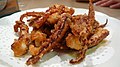 Geso karaage by Atari, Gracinha & Marco
 -
 Puntillitas
 -
 Rabas de calamar


.jpg)


