Akebia: Difference between revisions
CSV import |
CSV import |
||
| Line 37: | Line 37: | ||
[[Category:Climbing plants]] | [[Category:Climbing plants]] | ||
[[Category:Medicinal plants]] | [[Category:Medicinal plants]] | ||
== Akebia == | |||
<gallery> | |||
File:Akebia_quinata02.jpg|Akebia quinata | |||
File:Leaf_of_Ching.jpg|Leaf of Ching | |||
File:Akebia_longeracemosa_(14168601575).jpg|Akebia longeracemosa | |||
File:Akebia_quinata_003.JPG|Akebia quinata | |||
File:Akebia_trifoliata1.jpg|Akebia trifoliata | |||
File:Akebia_in_PNW.jpg|Akebia in PNW | |||
File:Aquinataflesh.jpg|Aquinata flesh | |||
File:AkebiaTrifoliata_fruit.JPG|Akebia Trifoliata fruit | |||
</gallery> | |||
Latest revision as of 11:24, 25 February 2025
Akebia[edit]
Akebia quinata, commonly known as chocolate vine
Akebia is a genus of flowering plants in the family Lardizabalaceae. It is native to East Asia and is known for its attractive foliage and unique flowers. The most well-known species in this genus is Akebia quinata, commonly referred to as chocolate vine due to its chocolate-scented flowers.
Description[edit]
Akebia plants are deciduous climbers that can reach a height of up to 10 meters. They have compound leaves with five leaflets that are arranged in a palmate manner. The leaves are dark green and provide an elegant backdrop to the flowers. The flowers of Akebia are small and bell-shaped, with a purplish-brown color. They have a pleasant fragrance that resembles the scent of chocolate, hence the common name "chocolate vine". The fruits of Akebia are elongated pods that contain edible pulp and seeds.
Cultivation[edit]
Akebia plants are popular choices for ornamental gardens due to their attractive foliage and unique flowers. They are relatively easy to grow and can tolerate a wide range of soil conditions. Akebia prefers partial shade to full sun and requires regular watering. It is a fast-growing vine that can quickly cover trellises, fences, or arbors. Pruning is recommended to control its growth and maintain its shape.
Uses[edit]
In addition to its ornamental value, Akebia has some practical uses as well. The fruits of Akebia quinata are edible and have a sweet taste. They can be eaten raw or used in various culinary preparations, such as jams, jellies, and desserts. The pulp of the fruit is juicy and has a refreshing flavor. Akebia is also used in traditional medicine for its potential health benefits, including its antioxidant properties.
Conservation[edit]
Some species of Akebia, such as Akebia trifoliata, are considered invasive in certain regions outside their native range. They can spread rapidly and outcompete native plant species, leading to ecological imbalances. It is important to be cautious when planting Akebia in areas where it is not native and to prevent its spread into natural habitats.
References[edit]
<references />
See also[edit]
Akebia[edit]
-
 Akebia quinata
 -
 Leaf of Ching
 -
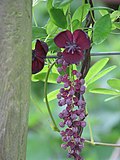 Akebia longeracemosa
 -
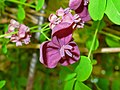 Akebia quinata
 -
 Akebia trifoliata
 -
 Akebia in PNW
 -
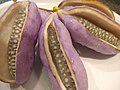 Aquinata flesh
 -
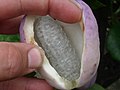 Akebia Trifoliata fruit


.jpg)


