Kunitz domain: Difference between revisions
CSV import |
CSV import |
||
| Line 30: | Line 30: | ||
{{protein-stub}} | {{protein-stub}} | ||
{{No image}} | {{No image}} | ||
<gallery> | |||
File:PDB_1kth_EBI.jpg|PDB 1kth EBI | |||
</gallery> | |||
Revision as of 23:57, 24 February 2025
Kunitz Domain
The Kunitz domain is a protein domain that was first identified in the bovine pancreatic trypsin inhibitor (BPTI), a protein that belongs to the Kunitz-type protease inhibitor family. This domain is approximately 60 amino acids in length and is characterized by a specific fold that is stabilized by three disulfide bonds.
Structure
The Kunitz domain has a compact protein structure that is stabilized by three disulfide bonds. These bonds are formed between six cysteine residues that are conserved in the Kunitz domain sequence. The domain's structure also includes two beta sheets and one alpha helix, arranged in a specific orientation that is characteristic of the Kunitz domain.
Function
The primary function of the Kunitz domain is to inhibit serine proteases, a type of enzyme that breaks down proteins. The domain achieves this by binding to the enzyme's active site, preventing it from interacting with its substrate. However, not all proteins containing a Kunitz domain are protease inhibitors. Some, such as the amyloid precursor protein, use the Kunitz domain for other functions, including cell adhesion and neurite outgrowth.
Distribution
Kunitz domains are found in a wide range of organisms, from bacteria to mammals. They are particularly common in venomous creatures, such as snakes and sea anemones, where they are used to inhibit the prey's proteases and immobilize it.
Clinical significance
Due to their role in protease inhibition, Kunitz domains are of interest in the development of drugs for conditions that involve excessive protease activity, such as inflammation, cancer, and coagulation disorders.
See also

-
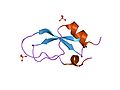 PDB 1kth EBI

