Cyanoacrylate: Difference between revisions
CSV import Tags: mobile edit mobile web edit |
CSV import Tags: mobile edit mobile web edit |
||
| Line 25: | Line 25: | ||
{{Chemistry-stub}} | {{Chemistry-stub}} | ||
{{Medicine-stub}} | {{Medicine-stub}} | ||
== Cyanoacrylate == | |||
<gallery> | |||
File:CyanoacrylatePolymer.svg|Cyanoacrylate Polymer | |||
File:Harry_Wesley_Coover_Jr.png|Harry Wesley Coover Jr | |||
File:Ethyl_cyanoacrylate.svg|Ethyl Cyanoacrylate | |||
File:Cyanacrylat_polymerisation.svg|Cyanacrylate Polymerisation | |||
File:Super_glue.jpg|Super Glue | |||
File:Incision_wound_on_child's_arm,_closed_with_Dermabond.jpg|Incision wound on child's arm, closed with Dermabond | |||
</gallery> | |||
Latest revision as of 23:57, 24 February 2025
Cyanoacrylate is a family of strong, fast-acting adhesives with industrial, medical, and household uses. The chemical basis of these adhesives is cyanoacrylate ester, which rapidly polymerizes in the presence of moisture, forming long, strong chains joining the bonded surfaces. Due to their unique properties, cyanoacrylate adhesives are often referred to as "super glues."
Chemistry[edit]
Cyanoacrylates are a group of monomers based on esters of 2-cyanoacrylic acid. The general chemical formula for cyanoacrylate is C5H5NO2. These monomers rapidly polymerize in the presence of water (usually moisture in the air), forming long, strong polymer chains. This reaction occurs via anionic mechanism and is catalyzed by basic substances, including the hydroxide ions found in water.
Medical Uses[edit]
In the medical field, cyanoacrylate adhesives are used as surgical sutures and for wound closure. They offer several advantages over traditional suturing techniques, including reduced closure time, minimal tissue reaction, and elimination of the need for suture removal. Medical grade cyanoacrylates include derivatives such as 2-octyl cyanoacrylate, which are designed to be more flexible and less toxic than the standard methyl cyanoacrylate used in household glues.
Industrial and Household Uses[edit]
Cyanoacrylate adhesives are widely used in both industrial and household settings due to their strong bonding capabilities. In industry, they are used for bonding metal, plastic, and rubber components, where their rapid curing time and strong bond strength are highly valued. In households, cyanoacrylate glues are commonly used for quick repairs and DIY projects, bonding a wide range of materials including plastics, ceramics, and wood.
Safety and Handling[edit]
While cyanoacrylate adhesives are invaluable tools, they require careful handling. Their strong bonding ability can pose a risk of skin adhesion or eye irritation upon contact. It is recommended to use gloves and eye protection when handling these adhesives. In case of skin contact, soaking the affected area in warm soapy water is usually sufficient to remove the adhesive.
Environmental Impact[edit]
The environmental impact of cyanoacrylate is relatively low compared to other adhesives. They do not contain solvents that can evaporate and cause air pollution. However, disposal of unused cyanoacrylate should be done with care, as polymerized cyanoacrylate can be a plastic pollutant.
Conclusion[edit]
Cyanoacrylate adhesives, with their rapid bonding capabilities and versatility, have become indispensable in various fields, including medical, industrial, and household applications. Their unique chemistry allows for strong, durable bonds across a wide range of materials, making them a valuable tool in many settings.


Cyanoacrylate[edit]
-
 Cyanoacrylate Polymer
 -
 Harry Wesley Coover Jr
 -
 Ethyl Cyanoacrylate
 -
 Cyanacrylate Polymerisation
 -
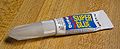 Super Glue
 -
 Incision wound on child's arm, closed with Dermabond


