Pain in invertebrates: Difference between revisions
CSV import Tags: mobile edit mobile web edit |
CSV import |
||
| Line 28: | Line 28: | ||
{{Ethology-stub}} | {{Ethology-stub}} | ||
<gallery> | |||
File:Monarch_Butterfly_Danaus_plexippus_Vertical_Caterpillar_2000px.jpg|Monarch Butterfly Danaus plexippus Vertical Caterpillar | |||
File:Spider_internal_anatomy-en.svg|Spider internal anatomy | |||
File:Octopus_shell.jpg|Octopus shell | |||
File:Svømmende_blodigle.JPG|Swimming leech | |||
File:Sea_hare2,_Aplysia_dactylomela,_12_04_2009_2-00pm.jpg|Sea hare Aplysia dactylomela | |||
File:Procambarus_clarkii.jpg|Procambarus clarkii | |||
File:Pseudoceros_dimidiatus.jpg|Pseudoceros dimidiatus | |||
File:Fruit_fly_larva_01.jpg|Fruit fly larva | |||
</gallery> | |||
Latest revision as of 23:50, 24 February 2025
Pain in Invertebrates is a complex and somewhat controversial topic within the fields of ethology, neuroscience, and animal welfare. The question of whether invertebrates experience pain similarly to vertebrates involves understanding the physiological and behavioral responses of these organisms to noxious stimuli.
Definition and Importance[edit]
Pain, in a broad sense, is an unpleasant sensory and emotional experience associated with actual or potential tissue damage. In vertebrates, it is a complex experience involving sensory, emotional, and cognitive components. However, the application of this definition to invertebrates is challenging due to their diverse physiological structures and nervous systems.
Understanding pain in invertebrates is crucial for several reasons. It has implications for the ethical treatment of animals, particularly in contexts such as research, pest control, and food production. Additionally, studying pain in invertebrates can provide insights into the evolution of pain perception and the fundamental biological mechanisms underlying it.
Physiological Basis[edit]
Invertebrates, unlike vertebrates, do not have a centralized brain but possess nervous systems that can detect and respond to harmful stimuli. For example, cephalopods like octopuses have complex nervous systems and exhibit behaviors suggesting a capacity for pain perception. They can learn to avoid harmful stimuli, indicating an awareness of discomfort.
The presence of nociceptors, or pain receptors, is a key factor in pain perception. Some invertebrates have been found to have nociceptors that react to potentially damaging stimuli. However, the mere presence of nociceptors does not conclusively prove the experience of pain as understood in vertebrates.
Behavioral Evidence[edit]
Behavioral responses to noxious stimuli are often used as indicators of pain perception. Invertebrates, including arthropods and cephalopods, display avoidance behaviors, protective reflexes, and physiological changes in response to harmful stimuli, suggesting a level of nociception. For instance, certain species of crabs will adjust their behavior to avoid electric shocks, indicating a capacity to learn from potentially painful experiences.
Ethical Considerations[edit]
The possibility that invertebrates might experience pain has led to discussions about their ethical treatment. This is particularly relevant in scientific research, where the use of invertebrates as model organisms is common. Legislation in some countries now includes cephalopods under animal welfare laws, reflecting growing concern for their welfare.
Controversies and Challenges[edit]
One of the main challenges in studying pain in invertebrates is the lack of a clear, universally accepted definition of pain that can be applied across all species. Additionally, the subjective nature of pain makes it difficult to assess in non-verbal organisms. Skeptics argue that behavioral responses to noxious stimuli in invertebrates can be explained by simple reflexive actions rather than a conscious experience of pain.
Conclusion[edit]
While definitive evidence for pain perception in invertebrates remains elusive, the complexity of their behaviors and physiological responses to noxious stimuli suggests a capacity for a pain-like experience. Ongoing research into the neurobiological mechanisms underlying these responses will be crucial in furthering our understanding of pain in invertebrates and its implications for their welfare.

-
 Monarch Butterfly Danaus plexippus Vertical Caterpillar
 -
 Spider internal anatomy
 -
 Octopus shell
 -
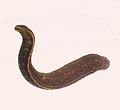 Swimming leech
 -
 Sea hare Aplysia dactylomela
 -
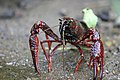 Procambarus clarkii
 -
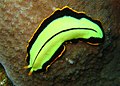 Pseudoceros dimidiatus
 -
 Fruit fly larva


