Phytochrome: Difference between revisions
CSV import |
CSV import |
||
| Line 23: | Line 23: | ||
[[Category:Light signals]] | [[Category:Light signals]] | ||
{{Plant-stub}} | {{Plant-stub}} | ||
== Phytochrome == | |||
<gallery> | |||
File:3G6O.pdb.jpg|3G6O.pdb | |||
File:Phytochrome|Phytochrome | |||
File:Phytochrome_str.png|Phytochrome structure | |||
File:Phy-chromo-spectra_Kopie.gif|Phytochrome spectra | |||
File:Kuvetten-small.jpg|Kuvetten | |||
</gallery> | |||
Revision as of 21:34, 23 February 2025
Phytochrome is a type of photoreceptor in plants, bacteria and fungi that is sensitive to light in the red and far-red region of the visible spectrum. Phytochromes play a crucial role in controlling plant growth and development in response to light.
Structure
Phytochromes are large proteins with a molecular weight of about 120,000. They consist of a protein part, known as the apoprotein, and a non-protein part, called the chromophore. The chromophore is a linear tetrapyrrole compound and is responsible for the light-sensitivity of the phytochrome.
Function
Phytochromes regulate a variety of plant growth and developmental processes, including seed germination, stem elongation, leaf expansion, chlorophyll synthesis, and the timing of flowering. They do this by absorbing light and converting it into a signal that changes the expression of genes in the plant's cells.
Phytochrome and Light
Phytochromes exist in two different forms: Pr and Pfr. Pr absorbs red light and converts to Pfr, while Pfr absorbs far-red light and converts back to Pr. This conversion process is known as photoconversion. The ratio of Pr to Pfr in plant cells can influence plant growth and development.
Phytochrome in Other Organisms
In addition to plants, phytochromes are also found in some bacteria and fungi. In these organisms, phytochromes are involved in controlling processes such as photosynthesis and circadian rhythms.
See Also

Phytochrome
-
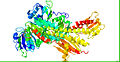 3G6O.pdb
 -
Phytochrome
-
 Phytochrome structure
 -
Phytochrome spectra
-
Kuvetten


