Veil: Difference between revisions
CSV import |
CSV import Tags: mobile edit mobile web edit |
||
| Line 38: | Line 38: | ||
{{Clothing-stub}} | {{Clothing-stub}} | ||
<gallery> | |||
File:Chief_Vestal.jpg|Chief Vestal | |||
File:Bronze_Statuette_of_a_Veiled_and_Masked_Dancer_1.jpg|Bronze Statuette of a Veiled and Masked Dancer | |||
File:Veils_bavaria_ncd_2012.jpg|Veils Bavaria NCD 2012 | |||
File:A_Coptic_woman_of_the_Poorer_Class._(1918)_-_TIMEA.jpg|A Coptic Woman of the Poorer Class | |||
File:Targui.jpg|Targui | |||
File:Sehrabandi.png|Sehrabandi | |||
File:Women_praying_in_the_Western_Wall_tunnels_by_David_Shankbone.jpg|Women Praying in the Western Wall Tunnels | |||
File:Hutterer-Crystal_Schule1.jpg|Hutterer Crystal Schule | |||
File:Kerkdienst_hhk_doornspijk.jpg|Kerkdienst HHK Doornspijk | |||
File:Te_Deum_Elizarovo_Guslitsa_8484.jpg|Te Deum Elizarovo Guslitsa | |||
File:Aer_on_a_Chalice_and_Discos.jpg|Aer on a Chalice and Discos | |||
File:Autel.matutinal.abbaye.Saint.Denis.png|Autel Matutinal Abbaye Saint Denis | |||
</gallery> | |||
Latest revision as of 21:34, 23 February 2025
 This article is about the garment.
   For the metaphorical use, see Veil (metaphor).
A veil is a piece of fabric that is intended to cover some part of the head or face, or an object of some significance. Veils are worn by people as part of traditional or religious attire, or to protect and conceal the face for various reasons. The use of the veil carries significant cultural and religious meanings in different societies around the world.
History[edit]
The history of the veil dates back to antiquity. The practice of veiling is documented in the ancient civilizations of the Middle East, including the cultures of Sumer, Babylon, and Ancient Egypt. In these societies, veils were used primarily by women and signified a range of social, religious, and political meanings.
In Ancient Greece and Rome, veils were worn by women as a symbol of modesty and privacy, especially among the upper classes. The veil in these cultures was also a marker of social status and distinction.
Cultural Significance[edit]
In many cultures, veils are worn as a part of traditional costumes and during special ceremonies and rituals. The significance of the veil varies:
- In Islam, the veil, known as Hijab or Burqa, is worn by many Muslim women as a sign of modesty and privacy. The Islamic veil has become a subject of political and social discussion, especially regarding its implications for gender and identity in Muslim societies and beyond.
- In Christianity, veils have been used in various contexts, such as by nuns or during certain ceremonies, including weddings where brides wear veils as a symbol of purity.
- In Judaism, the veil has historical significance, as seen in the traditional Jewish wedding where the bride wears a veil, symbolizing modesty and the groom's commitment to clothe and protect his wife.
Types of Veils[edit]
There are various types of veils, which include:
- Bridal veils: Worn by brides on their wedding day.
- Religious veils: Such as the hijab, niqab, and burqa in Islam, and habits worn by nuns in Christianity.
- Funerary veils: Used to cover the face of the deceased, often symbolizing respect and mourning.
Controversies and Laws[edit]
The wearing of veils has been at the center of many controversies, especially concerning issues of integration, women's rights, and secularism. Some countries have enacted laws restricting the wearing of veils in public spaces, particularly full-face veils such as the burqa and niqab. These laws are often justified on security grounds or as measures to promote secular values.
In Popular Culture[edit]
Veils frequently appear in literature, film, and art, often used as symbols representing themes such as mystery, oppression, beauty, or liberation. The veil can serve as a powerful metaphor for revealing and concealing, playing a significant role in narrative and visual symbolism.
See Also[edit]

-
 Chief Vestal
 -
 Bronze Statuette of a Veiled and Masked Dancer
 -
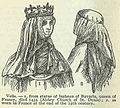 Veils Bavaria NCD 2012
 -
 A Coptic Woman of the Poorer Class
 -
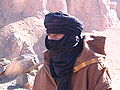 Targui
 -
 Sehrabandi
 -
 Women Praying in the Western Wall Tunnels
 -
 Hutterer Crystal Schule
 -
 Kerkdienst HHK Doornspijk
 -
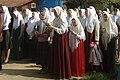 Te Deum Elizarovo Guslitsa
 -
 Aer on a Chalice and Discos
 -
 Autel Matutinal Abbaye Saint Denis


_-_TIMEA.jpg)


