Critical mass: Difference between revisions
CSV import Tags: mobile edit mobile web edit |
CSV import |
||
| Line 30: | Line 30: | ||
[[Category:Nuclear weapons]] | [[Category:Nuclear weapons]] | ||
{{stub}} | {{stub}} | ||
== Critical_mass == | |||
<gallery> | |||
File:Partially-reflected-plutonium-sphere.jpeg|Partially reflected plutonium sphere | |||
File:Critical_mass.svg|Critical mass | |||
File:Nuclear_predetonation.svg|Nuclear predetonation | |||
</gallery> | |||
Latest revision as of 21:32, 23 February 2025
Critical mass is a term used in nuclear physics to describe the smallest amount of fissile material needed for a sustained nuclear chain reaction. The critical mass of a fissionable material depends upon its nuclear properties, its density, its shape, its enrichment, its purity, its temperature, and its surroundings.
Nuclear Physics[edit]
In nuclear physics, the critical mass is the minimum amount of nuclear material needed to make a nuclear bomb. It is the amount needed for a sustained nuclear chain reaction. The critical mass of a nuclear material depends on its nuclear properties (e.g., the nuclear fission cross-section), its density, its shape, its enrichment, its purity, its temperature, and its surroundings.
Fissile Material[edit]
Fissile material is material capable of sustaining a nuclear fission chain reaction. By definition, fissile material can sustain a chain reaction with neutrons of any energy. The predominant neutron energy may be typified by either slow neutrons (i.e., a thermal system) or fast neutrons.
Nuclear Chain Reaction[edit]
A nuclear chain reaction occurs when one single nuclear reaction causes an average of one or more subsequent nuclear reactions, thus leading to the possibility of a self-propagating series of these reactions. The specific nuclear reaction may be the fission of heavy isotopes (e.g., uranium-235, 235U).
See Also[edit]
References[edit]
<references />
 | This medical article is a stub. You can help WikiMD by expanding the page. |
Critical_mass[edit]
-
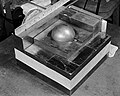 Partially reflected plutonium sphere
 -
 Critical mass
 -
 Nuclear predetonation


