Sawdust: Difference between revisions
CSV import |
CSV import |
||
| Line 25: | Line 25: | ||
{{stub}} | {{stub}} | ||
{{dictionary-stub1}} | {{dictionary-stub1}} | ||
== Sawdust == | |||
<gallery> | |||
File:Saw_dust_(Zaagsel).jpg|Saw dust (Zaagsel) | |||
File:Ogatan(JapaneseBriquetteCharcoal).jpg|Ogatan (Japanese Briquette Charcoal) | |||
File:Sawdust_vendors._Kashgar_markets.jpg|Sawdust vendors, Kashgar markets | |||
File:Wood_Shavings_from_a_Chainsaw.jpg|Wood Shavings from a Chainsaw | |||
File:Particle_size_distribution_of_hardwood_dust.jpg|Particle size distribution of hardwood dust | |||
File:Japanese_handplane_(kanna)_with_wood_shavings.jpg|Japanese handplane (kanna) with wood shavings | |||
File:A_waste_wood_powder.jpg|A waste wood powder | |||
</gallery> | |||
Latest revision as of 21:32, 23 February 2025
Sawdust or wood dust is a by-product or waste product of woodworking operations such as sawing, milling, planing, routing, drilling and sanding. It is composed of fine particles of wood. These operations can be performed by woodworking machinery, portable power tools or by use of hand tools.
Uses[edit]
Sawdust has a variety of practical uses, including serving as a mulch, as an alternative to clay cat litter, or as a fuel. Until the advent of refrigeration, it was often used in icehouses to keep ice frozen during the summer. It has been used in artistic displays, and as scatter in miniature railroad and other models. It is also sometimes used to soak up liquid spills, allowing the spill to be easily collected or swept aside. As such, it was formerly common on barroom floors. It is used to make Cutler's resin. Mixed with water and frozen, it forms pykrete, a slow-melting, much stronger form of ice.
Sawdust is used in the manufacture of charcoal briquettes. The claim for invention of the first commercial charcoal briquettes goes to Henry Ford who created them from the wood scraps and sawdust produced by his automobile factory.
Health hazards[edit]
Wood dust becomes a potential health problem when, for example, the wood particles, from processes such as sanding, become airborne and are inhaled. Wood dust is a known human carcinogen. Certain woods and their dust contain toxins that can produce severe allergic reactions.
See also[edit]
References[edit]
<references />
 | |
|---|---|
 |
 |
Sawdust[edit]
-
 Saw dust (Zaagsel)
 -
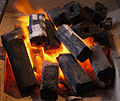 Ogatan (Japanese Briquette Charcoal)
 -
 Sawdust vendors, Kashgar markets
 -
 Wood Shavings from a Chainsaw
 -
 Particle size distribution of hardwood dust
 -
 Japanese handplane (kanna) with wood shavings
 -
 A waste wood powder
.jpg)
.jpg)


_with_wood_shavings.jpg)

