Axillary nerve: Difference between revisions
CSV import Tags: mobile edit mobile web edit |
CSV import |
||
| Line 24: | Line 24: | ||
[[Category:Peripheral nervous system]] | [[Category:Peripheral nervous system]] | ||
{{medicine-stub}} | {{medicine-stub}} | ||
== Axillary nerve == | |||
<gallery> | |||
File:Brachial_plexus_2.svg|Brachial plexus 2 | |||
File:Gray818.png|Gray 818 | |||
File:Brachial_plexus_color.svg|Brachial plexus color | |||
File:Gray810.png|Gray 810 | |||
File:Gray811and813.PNG|Gray 811 and 813 | |||
File:Gray812and814.svg|Gray 812 and 814 | |||
File:Slide6a.JPG|Slide 6a | |||
File:Slide2dj.JPG|Slide 2dj | |||
File:Slide12dj.JPG|Slide 12dj | |||
File:Slide18OOO.JPG|Slide 18 OOO | |||
</gallery> | |||
Latest revision as of 21:29, 23 February 2025
Axillary Nerve
The axillary nerve or the circumflex nerve is a nerve of the human body, arising from the brachial plexus, specifically from the posterior cord, and is responsible for innervating the deltoid muscle, a portion of the trapezius muscle, and the skin over part of the deltoid and the upper lateral arm. It is crucial for the movement and sensation in these areas.
Anatomy[edit]
The axillary nerve originates from the posterior cord of the brachial plexus, receiving fibers from the C5 and C6 nerve roots. It courses posteriorly through the axilla, wrapping around the surgical neck of the humerus bone, and divides into anterior and posterior branches. The anterior branch innervates the anterior part of the deltoid muscle, while the posterior branch supplies the posterior deltoid and the teres minor muscle, as well as giving off sensory branches to the skin.
Function[edit]
The primary function of the axillary nerve is motor innervation to the deltoid and teres minor muscles. The deltoid muscle is essential for abduction, flexion, and extension of the arm at the shoulder joint. The teres minor muscle assists in the lateral rotation of the arm. Additionally, the axillary nerve provides sensory innervation to the skin covering the inferior region of the deltoid muscle, known as the regimental badge area due to its location where military insignia are worn.
Clinical Significance[edit]
Injury to the axillary nerve can occur due to shoulder dislocation, fractures of the humerus, or during surgical procedures in the axillary region. Symptoms of axillary nerve damage include weakness or paralysis of the deltoid muscle, loss of sensation in the skin area innervated by the nerve, and an inability to abduct the arm beyond 15 degrees from the side. Diagnosis is typically made through a combination of physical examination, patient history, and sometimes electrophysiological studies.
Treatment[edit]
Treatment of axillary nerve injury depends on the cause and severity of the damage. Conservative treatment includes physical therapy to maintain muscle tone and prevent joint stiffness. In cases of severe injury or when conservative management fails, surgical intervention may be necessary to repair or graft the nerve. Prognosis varies, with some patients experiencing full recovery and others having persistent weakness or sensory loss.
See Also[edit]

Axillary nerve[edit]
-
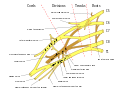 Brachial plexus 2
 -
 Gray 818
 -
 Brachial plexus color
 -
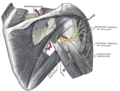 Gray 810
 -
 Gray 811 and 813
 -
 Gray 812 and 814
 -
Slide 6a
-
Slide 2dj
-
Slide 12dj
-
Slide 18 OOO


