Hail: Difference between revisions
CSV import Tags: mobile edit mobile web edit |
CSV import |
||
| Line 30: | Line 30: | ||
{{stub}} | {{stub}} | ||
{{dictionary-stub1}} | {{dictionary-stub1}} | ||
<gallery> | |||
File:Granizo.jpg|Granizo | |||
File:hailshaft.jpg|Hailshaft | |||
File:Hail_clouds.jpg|Hail clouds | |||
File:Thakurgaon_Hailstorm.webm|Thakurgaon Hailstorm | |||
File:Three_body_scatter_spike-NOAA.png|Three body scatter spike | |||
File:Hailstones.jpg|Hailstones | |||
File:Hagelkorn_mit_Anlagerungsschichten.jpg|Hagelkorn mit Anlagerungsschichten | |||
File:Record_hailstone_Vivian,_SD.jpg|Record hailstone Vivian, SD | |||
File:Wea02208_-_Flickr_-_NOAA_Photo_Library.jpg|Wea02208 - Flickr - NOAA Photo Library | |||
File:Sydneyhailstorm.jpg|Sydney hailstorm | |||
File:Hand_holding_hail_in_a_strawberry_patch.jpg|Hand holding hail in a strawberry patch | |||
File:Banska_Stiavnica_Cannon-1.JPG|Banska Stiavnica Cannon | |||
</gallery> | |||
Latest revision as of 21:21, 23 February 2025
Hail is a form of solid precipitation that is produced by cumulonimbus thunderclouds. It consists of balls or irregular lumps of ice, known as hailstones. Hailstones on Earth consist mostly of water ice and measure between 5 millimeters (0.2 in) and 15 centimeters (6 in) in diameter.
Formation[edit]
Hail forms in strong thunderstorm clouds, particularly those with intense updrafts, high liquid water content, great vertical extent, large water droplets, and where a good portion of the cloud layer is below freezing 0 °C (32 °F). These types of strong updrafts can also indicate the presence of a tornado.
The growth rate of hailstones is impacted by factors such as higher elevation, lower freezing zones, and wind direction.
Types of Hail[edit]
There are three types of hail: Soft Hail, Small Hail, and Large Hail. Soft hail, or snow pellets, are small, white, opaque grains of ice that are round or irregular in shape. Small hail is the size of a pea to the size of a grape. Large hail is the size of a walnut to the size of a grapefruit.
Effects of Hail[edit]
Hail can cause serious damage, notably to automobiles, aircraft, skylights, glass-roofed structures, livestock, and crops. Rarely, massive hailstones have been known to cause concussions or fatal head trauma.
Prevention and Mitigation[edit]
Hail damage to roofs often goes unnoticed until further structural damage is seen, such as leaks or cracks. It is hardest to recognize hail damage on shingled roofs and flat roofs, but all roofs have their own hail damage detection problems.
See Also[edit]
References[edit]
<references />
 | |
|---|---|
 |
 |
-
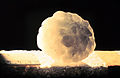 Granizo
 -
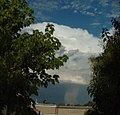 Hailshaft
 -
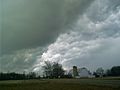 Hail clouds
 -
 Thakurgaon Hailstorm
 -
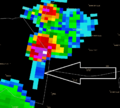 Three body scatter spike
 -
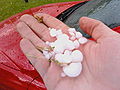 Hailstones
 -
 Hagelkorn mit Anlagerungsschichten
 -
 Record hailstone Vivian, SD
 -
 Wea02208 - Flickr - NOAA Photo Library
 -
 Sydney hailstorm
 -
 Hand holding hail in a strawberry patch
 -
 Banska Stiavnica Cannon


