HEPA: Difference between revisions
CSV import Tags: mobile edit mobile web edit |
CSV import |
||
| Line 30: | Line 30: | ||
{{stub}} | {{stub}} | ||
<gallery> | |||
File:HEPA_Filter_diagram_en.svg|HEPA Filter diagram | |||
File:Filter_collection_mechanisms.svg|Filter collection mechanisms | |||
File:Filteration_Collection_Mechanisms-en.svg|Filtration Collection Mechanisms | |||
File:HEPA_filter_unit.jpg|HEPA filter unit | |||
File:Portable_powered_HEPA_respirator.jpg|Portable powered HEPA respirator | |||
File:PHILIPS_HEPA_H10_air_filter_for_vacuum_cleaner.JPG|PHILIPS HEPA H10 air filter for vacuum cleaner | |||
File:Display_VSON_WP6910_(air_detector)_-_pm2,5_at_Verona_(Borgo_Milano)_Italy_-_(particulate_pollution,_polveri_sottili)_-_2020_01_30_(hour_22-37)_-_OUTdoor_and_INdoor_(HEPA_H13_filter)_-_first_publication_commons.wikimedia.org.webm|Display VSON WP6910 (air detector) - pm2.5 at Verona (Borgo Milano) Italy - (particulate pollution, polveri sottili) - 2020 01 30 (hour 22-37) - OUTdoor and INdoor (HEPA H13 filter) - first publication commons.wikimedia.org | |||
</gallery> | |||
Latest revision as of 21:19, 23 February 2025
HEPA or High Efficiency Particulate Air is a type of air filter that can trap a large amount of very small particles that other vacuum cleaners would simply recirculate back into the air of your home. HEPA filters are made from tiny glass fibers that are made into a dense paper-like material.
History[edit]
The HEPA filter was developed during World War II to prevent the spread of radioactive particles as part of the Manhattan Project. After the war, the technology was declassified and made available for commercial and residential use.
Function[edit]
HEPA filters are designed to target much smaller pollutants and particles. These particles are trapped (they stick to a fiber) through a combination of the following three mechanisms:
- Interception: When particles following a line of flow in the air stream come within one radius of a fiber and adhere to it.
- Impaction: When larger particles are unable to avoid fibers by following the curving contours of the air stream and are forced to embed in one of them directly; this effect increases with diminishing fiber separation and higher air flow velocity.
- Diffusion: An enhancing mechanism that is a result of the collision with gas molecules by the smallest particles, especially those below 0.1 µm in diameter, which are thereby impeded and delayed in their path through the filter; this behavior is similar to Brownian motion and raises the probability that a particle will be stopped by either of the two mechanisms above; it becomes dominant at lower air flow velocities.
Standards[edit]
HEPA filters, as defined by the United States Department of Energy (DOE) standard adopted by most American industries, remove at least 99.97% of airborne particles that are 0.3 micrometers in diameter. The European standard EN 1822:2009 has several different classes for HEPA filters.
Applications[edit]
HEPA filters are used in various applications, such as residential homes, commercial spaces, and industrial applications where clean air is required. They are also used in medical facilities, automobiles, aircraft, and even in the construction of spacecraft.
See Also[edit]
 | |
|---|---|
 |
 |
-
 HEPA Filter diagram
 -
 Filter collection mechanisms
 -
 Filtration Collection Mechanisms
 -
 HEPA filter unit
 -
 Portable powered HEPA respirator
 -
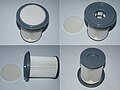 PHILIPS HEPA H10 air filter for vacuum cleaner
 -
 Display VSON WP6910 (air detector) - pm2.5 at Verona (Borgo Milano) Italy - (particulate pollution, polveri sottili) - 2020 01 30 (hour 22-37) - OUTdoor and INdoor (HEPA H13 filter) - first publication commons.wikimedia.org


