Bartholin's gland: Difference between revisions
CSV import |
CSV import Tags: mobile edit mobile web edit |
||
| Line 28: | Line 28: | ||
[[Category:Female reproductive system]] | [[Category:Female reproductive system]] | ||
{{anatomy-stub}} | {{anatomy-stub}} | ||
== Bartholin's_gland == | |||
<gallery> | |||
File:Skenes_gland.jpg|Skenes gland | |||
File:Bartholin_-_De_ovariis_mulierum_et_generationis_historia_epistola_anatomica,_1678_-_3036572.tif|Bartholin - De ovariis mulierum et generationis historia epistola anatomica, 1678 | |||
</gallery> | |||
Latest revision as of 21:17, 23 February 2025
Bartholin's gland is a pair of pea-sized, tubuloalveolar, exocrine glands located slightly posterior and to the left and right of the opening of the vagina. They secrete mucus to lubricate the vagina and are homologous to bulbourethral glands in males. However, while Bartholin's glands are located in the superficial perineal pouch in females, bulbourethral glands are located in the deep perineal pouch in males. Their duct length is approximately 1.5 to 2.0 cm and open into navicular fossa. The duct orifice is just external to the hymenal ring.
The fluid may slightly moisten the labial opening of the vagina, serving to make contact with this sensitive area more comfortable for the woman. It is possible for the Bartholin's glands to become blocked and inflamed resulting in a Bartholin's cyst. Bartholin's cysts are relatively common and women who are of reproductive age are particularly susceptible.
Anatomy[edit]
The Bartholin's glands are located in the vulva, one on each side of the vaginal opening. They are covered by the labia majora. They secrete mucus to provide vaginal lubrication during sexual arousal. The gland is homologous to the bulbourethral gland in males.
Function[edit]
The Bartholin's glands play a crucial role in the female reproductive system. They secrete mucus that provides lubrication for the vagina. This is particularly important during sexual intercourse as it makes the passage of the male penis into the vagina less abrasive to the female.
Clinical significance[edit]
The Bartholin's glands can sometimes become blocked, leading to a fluid-filled growth known as a Bartholin's cyst. If the cyst becomes infected, it can form an abscess. Bartholin's cysts are typically painless but can cause discomfort during physical activities such as walking and intercourse. Treatment options for Bartholin's cysts include sitz baths, surgical drainage, and in some cases, removal of the gland.
See also[edit]
References[edit]
<references group="" responsive="1"></references>

Bartholin's_gland[edit]
-
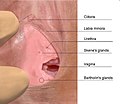 Skenes gland
 -
 Bartholin - De ovariis mulierum et generationis historia epistola anatomica, 1678

