Microsatellite: Difference between revisions
CSV import Tags: mobile edit mobile web edit |
CSV import |
||
| Line 30: | Line 30: | ||
{{Genetics-stub}} | {{Genetics-stub}} | ||
{{Forensics-stub}} | {{Forensics-stub}} | ||
<gallery> | |||
File:STR-Slippage_Dr.Peter_Forster.jpg|STR Slippage Dr. Peter Forster | |||
File:Str_profile.jpg|STR Profile | |||
File:Consensus_neighbor-joining_tree_of_the_249_human_populations_and_six_chimpanzee_populations.svg|Consensus Neighbor-Joining Tree of the 249 Human Populations and Six Chimpanzee Populations | |||
File:Short_Tandem_Repeat_(STR)_analysis.png|Short Tandem Repeat (STR) Analysis | |||
File:PAGE_AgStain_Microsat.jpg|PAGE AgStain Microsat | |||
</gallery> | |||
Latest revision as of 21:15, 23 February 2025
Microsatellites, also known as short tandem repeats (STRs) or simple sequence repeats (SSRs), are repeating sequences of 2-6 base pairs of DNA found throughout the genome, both in coding and non-coding regions. They are considered highly polymorphic due to the variation in repeat number among individuals, making them extremely useful in genetic studies, forensic science, and population genetics.
Characteristics[edit]
Microsatellites are characterized by their short sequence length and the simplicity of their repeating units. The number of repeats in a microsatellite can vary greatly among individuals, which is a property known as allelic diversity. This variability makes microsatellites excellent markers for DNA fingerprinting, genetic linkage analysis, and identity testing.
Formation and Mutation[edit]
The formation of microsatellites is believed to occur through DNA replication slippage, where the DNA polymerase slips on the template strand, leading to the addition or deletion of repeat units. This process results in a high mutation rate for microsatellites, further contributing to their variability. The mutation rate of microsatellites is influenced by the length of the repeat unit and the number of repeats, with longer repeats and larger numbers of repeats being more prone to mutation.
Applications[edit]
Microsatellites have a wide range of applications in biological research and forensic science:
- Genetic Diversity and Population Genetics: Microsatellites are used to assess genetic diversity within and between populations, helping in the study of population structure, migration patterns, and evolutionary history.
- Forensic Science: Due to their high variability, microsatellites are used in DNA profiling, where they can help in criminal investigations and paternity testing.
- Conservation Genetics: In conservation biology, microsatellites help in identifying genetically distinct populations, assessing genetic health, and planning for the conservation of endangered species.
- Cancer Research: Microsatellite instability (MSI) is a condition in which microsatellites are highly prone to mutation, leading to their use as biomarkers in certain types of cancer, such as colorectal cancer.
Microsatellite Instability (MSI)[edit]
Microsatellite instability (MSI) is a phenomenon observed in certain types of cancer where the DNA mismatch repair system is deficient, leading to an increased rate of mutation in microsatellites. MSI is a hallmark of various cancers, including Lynch syndrome, a hereditary condition that increases the risk of colon cancer and other cancers. Testing for MSI can be used in the diagnosis and management of these cancers.
Challenges and Limitations[edit]
While microsatellites are valuable tools in genetics and forensic science, they also present challenges. The high mutation rate of microsatellites can lead to allelic dropout (failure to detect one or more alleles at a locus) and stutter peaks (artifacts in the DNA sequencing process), complicating data analysis. Additionally, the development of microsatellite markers can be time-consuming and costly.
Conclusion[edit]
Microsatellites are powerful tools in the fields of genetics, forensic science, and conservation biology, offering insights into genetic diversity, population structure, and individual identification. Despite their challenges, the utility of microsatellites in research and applied science continues to make them a subject of significant interest.


-
 STR Slippage Dr. Peter Forster
 -
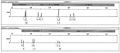 STR Profile
 -
 Consensus Neighbor-Joining Tree of the 249 Human Populations and Six Chimpanzee Populations
 -
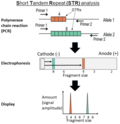 Short Tandem Repeat (STR) Analysis
 -
 PAGE AgStain Microsat


_analysis.png)

