Mangrove: Difference between revisions
CSV import |
CSV import Tags: mobile edit mobile web edit |
||
| Line 31: | Line 31: | ||
{{stub}} | {{stub}} | ||
{{dictionary-stub1}} | {{dictionary-stub1}} | ||
<gallery> | |||
File:Sonneratia_alba_-_Manado_(2).JPG|Sonneratia alba - Manado | |||
File:Mangrove_roots_at_low_tide.jpg|Mangrove roots at low tide | |||
File:Mangroves_in_Kannur,_India.jpg|Mangroves in Kannur, India | |||
File:Mangrove_(cropped).jpg|Mangrove | |||
File:Saltcrystals_on_avicennia_marina_var_resinifera_leaves.JPG|Salt crystals on Avicennia marina var resinifera leaves | |||
File:Pneumatophore_overkill_-_grey_mangrove.JPG|Pneumatophore overkill - grey mangrove | |||
File:Plody_mangrovnika_(Rhizophora_mangle).jpg|Plody mangrovnika (Rhizophora mangle) | |||
File:Water_filtration_in_mangrove_roots.webp|Water filtration in mangrove roots | |||
File:One_week_old_Mangarove,_Qatif,_Saudi_Arabia,_Late_August_2020_2_(cropped).jpg|One week old Mangrove, Qatif, Saudi Arabia, Late August 2020 | |||
File:Nypa_fruticans_-_Taki_-_North_24_Parganas_2015-01-13_4729.JPG|Nypa fruticans - Taki - North 24 Parganas | |||
File:Avicennia_alba.jpg|Avicennia alba | |||
</gallery> | |||
Latest revision as of 21:15, 23 February 2025
Mangroves are a group of trees and shrubs that live in the coastal intertidal zone. There are about 80 different species of mangrove trees. All of these trees grow in areas with low-oxygen soil, where slow-moving waters allow fine sediments to accumulate.
Biology[edit]
Mangrove trees are able to absorb much higher amounts of salt than typical trees. They are able to do this through a filtration system that is in their roots. The roots also take in oxygen from the air, as the soil they grow in is often depleted of oxygen.
Distribution[edit]
Mangroves are found in the tropics and subtropics, mainly between latitudes 25° N and 25° S. The total mangrove forest area of the world in 2000 was 137,800 square kilometers (53,200 sq mi), spanning 118 countries and territories.
Ecological importance[edit]
Mangroves play a crucial role in maintaining the health of coastal ecosystems. They provide habitat for a wide range of species, including birds, mammals, and fish. In addition, they help to protect coastlines from erosion and storm surges.
Threats[edit]
Mangroves are under threat from a variety of factors, including deforestation, pollution, and climate change. These threats have led to significant declines in mangrove populations in many parts of the world.
Conservation[edit]
Efforts are being made to conserve and restore mangrove forests. These efforts include the establishment of protected areas, the implementation of sustainable forestry practices, and the promotion of community-based conservation initiatives.
See also[edit]
References[edit]
<references />
 | |
|---|---|
 |
 |
-
 Sonneratia alba - Manado
 -
 Mangrove roots at low tide
 -
 Mangroves in Kannur, India
 -
 Mangrove
 -
 Salt crystals on Avicennia marina var resinifera leaves
 -
 Pneumatophore overkill - grey mangrove
 -
 Plody mangrovnika (Rhizophora mangle)
 -
 Water filtration in mangrove roots
 -
 One week old Mangrove, Qatif, Saudi Arabia, Late August 2020
 -
 Nypa fruticans - Taki - North 24 Parganas
 -
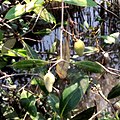 Avicennia alba
.JPG)


.jpg)


.jpg)

.jpg)


