Banana peel: Difference between revisions
CSV import Tags: mobile edit mobile web edit |
CSV import |
||
| Line 28: | Line 28: | ||
[[Category:Waste]] | [[Category:Waste]] | ||
{{fruit-stub}} | {{fruit-stub}} | ||
== Banana_peel == | |||
<gallery> | |||
File:Banana_(partially_peeled).jpg|Banana (partially peeled) | |||
File:Banane-A-05_cropped.jpg|Banane A 05 cropped | |||
File:Banana_peel_on_the_ground.jpg|Banana peel on the ground | |||
File:Banane_Obst.jpg|Banane Obst | |||
</gallery> | |||
Latest revision as of 21:05, 23 February 2025
Banana Peel
A banana peel, also known as a banana skin in British English, is the outer covering of the banana fruit. Banana peels are often discarded after the fruit is consumed, but they have various uses and benefits in different fields such as nutrition, beauty care, and gardening.
Composition[edit]
Banana peels are rich in potassium, fiber, protein, essential amino acids, polyunsaturated fatty acids, and several vitamins such as vitamin B6 and vitamin C. They also contain various antioxidants including dopamine and lutein.
Uses[edit]
Nutrition[edit]
Banana peels can be eaten and are often used in recipes in many cultures. They are usually cooked in some form due to their bitter taste when raw.
Beauty Care[edit]
Banana peels have been used in beauty care for their moisturizing properties. They are often used in homemade face masks and treatments for skin conditions such as acne and psoriasis.
Gardening[edit]
In gardening, banana peels can be used as a natural fertilizer due to their high potassium content. They can also be used in composting.
Environmental Impact[edit]
Discarded banana peels contribute to food waste. However, they are biodegradable and can be composted, reducing their environmental impact.
See Also[edit]

Banana_peel[edit]
-
 Banana (partially peeled)
 -
 Banane A 05 cropped
 -
 Banana peel on the ground
 -
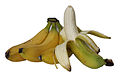 Banane Obst
.jpg)


