Bacteriology: Difference between revisions
Replaced content with "Bacteriology is the branch of microbiology that focuses on the study of bacteria, their structure, function, growth, pathogenesis, and the role they play in health..." Tag: Replaced |
CSV import |
||
| Line 49: | Line 49: | ||
{{Antonie van Leeuwenhoek}} | {{Antonie van Leeuwenhoek}} | ||
[[Category:Bacteriology| ]] | [[Category:Bacteriology| ]] | ||
<gallery> | |||
File:E._coli_Bacteria_(7316101966).jpg|E. coli Bacteria | |||
File:Colonies_de_legionelles.jpg|Colonies de legionelles | |||
File:Salmonella_growing_on_XLD_agar.JPG|Salmonella growing on XLD agar | |||
File:Anthonie_van_Leeuwenhoek_(1632-1723)._Natuurkundige_te_Delft_Rijksmuseum_SK-A-957.jpeg|Anthonie van Leeuwenhoek (1632-1723) | |||
File:Albert_Edelfelt_-_Louis_Pasteur_-_1885.jpg|Albert Edelfelt - Louis Pasteur - 1885 | |||
File:Statue_of_Robert_Koch_in_Berlin.jpg|Statue of Robert Koch in Berlin | |||
</gallery> | |||
Latest revision as of 20:57, 23 February 2025
Bacteriology is the branch of microbiology that focuses on the study of bacteria, their structure, function, growth, pathogenesis, and the role they play in health, disease, and the environment. This discipline encompasses the identification, classification, and characterization of bacterial species, as well as the harnessing of beneficial bacteria and the mitigation of harmful ones.
History[edit]
The history of bacteriology dates back to the 17th century with the discovery of microorganisms by Antonie van Leeuwenhoek, using his homemade microscopes. Significant contributions were made by Louis Pasteur, such as the disproval of spontaneous generation, and by Robert Koch, who established Koch's postulates to identify the causative agents of disease.
Branches[edit]
Bacteriology is divided into several branches, including:
- Medical bacteriology: Focuses on bacteria that cause diseases in humans and animals.
- Industrial bacteriology: Deals with the application of bacteria in industrial processes, such as fermentation and bioremediation.
- Agricultural bacteriology: Studies the role of bacteria in plant diseases, soil fertility, and crop production.
- Environmental bacteriology: Examines the behavior and function of bacteria in natural environments.
Methods of Study[edit]
Bacteriological research utilizes various methods, including:
- Microscopy: The use of microscopes to observe bacteria.
- Culture techniques: Growing bacteria in controlled conditions to study their properties.
- Molecular biology techniques: Employing methods such as PCR and sequencing to analyze genetic material.
- Biochemical tests: Determining bacterial species based on their biochemical activities.
Significance[edit]
Bacteriology has a profound impact on several fields, including:
- Medicine: Understanding pathogens to develop antibiotics and vaccines.
- Public health: Controlling and preventing bacterial outbreaks.
- Agriculture: Enhancing soil fertility and controlling plant diseases.
- Environmental science: Cleaning pollutants through bioremediation.
Applications[edit]
- Disease diagnosis and treatment: Identifying pathogens and determining their susceptibility to antibiotics.
- Biotechnology: Engineering bacteria for the production of pharmaceuticals, biofuels, and other chemicals.
- Food industry: Fermentation processes for the production of cheese, yogurt, and other products.
- Water treatment: Utilizing bacteria to break down organic waste in sewage treatment plants.
Challenges and Future Directions[edit]
Bacteriology faces challenges such as antibiotic resistance and emerging infectious diseases. Future research aims to develop new antimicrobial strategies, understand bacterial communities (microbiomes), and explore the potential of bacteriophages as therapeutic agents.
Also see[edit]
References[edit]
<references/>
Further Reading[edit]
- Microbe by Michele Swanson, Gemma Reguera, Moselio Schaechter, and Frederick Neidhardt.
- Brock Biology of Microorganisms by Michael T. Madigan, John M. Martinko, Kelly S. Bender, Daniel H. Buckley, and David A. Stahl.
External Links[edit]
 | |
|---|---|
 |
 |
| Antonie van Leeuwenhoek | ||||||||||||||
|---|---|---|---|---|---|---|---|---|---|---|---|---|---|---|
|
-
 E. coli Bacteria
 -
 Colonies de legionelles
 -
 Salmonella growing on XLD agar
 -
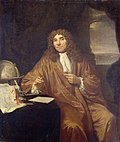 Anthonie van Leeuwenhoek (1632-1723)
 -
 Albert Edelfelt - Louis Pasteur - 1885
 -
 Statue of Robert Koch in Berlin
.jpg)


._Natuurkundige_te_Delft_Rijksmuseum_SK-A-957.jpeg)


