Flamenco: Difference between revisions
CSV import |
CSV import |
||
| Line 32: | Line 32: | ||
{{stub}} | {{stub}} | ||
== Flamenco == | |||
<gallery> | |||
File:Belen_maya.jpg|Belen maya | |||
File:EMILIO_BEAUCHY,_Café_cantante,_hacia_1885,_copia_a_la_albúmina.jpg|EMILIO BEAUCHY, Café cantante, hacia 1885, copia a la albúmina | |||
File:Reima-Nikkinen-1971.jpg|Reima Nikkinen 1971 | |||
File:Palos_flamencos.jpg|Palos flamencos | |||
File:E_Phrygian_Scale.PNG|E Phrygian Scale | |||
File:Flamenco_Compas.theora.ogv|Flamenco Compas | |||
File:Tablao_Cordobés_06.jpg|Tablao Cordobés 06 | |||
File:Deborah_Greenfield.jpg|Deborah Greenfield | |||
File:Castelucho.jpg|Castelucho | |||
File:Theatre_Flamenco_Work_Sample.webm|Theatre Flamenco Work Sample | |||
File:Baile_andaluz_1893_José_Villegas_Cordero.jpg|Baile andaluz 1893 José Villegas Cordero | |||
File:Sargent_John_Singer_Spanish_Dancer.jpg|Sargent John Singer Spanish Dancer | |||
</gallery> | |||
Latest revision as of 20:56, 23 February 2025
Flamenco is a form of Spanish folk music and dance from the region of Andalusia in southern Spain. It includes singing (cante), guitar playing (toque), dance (baile) and palmas, handclapping, and pitos, finger snapping.
History[edit]
Flamenco originated in the southern regions of Spain, but its exact origins are unknown. The most widely accepted hypothesis is that flamenco was developed through the cross-cultural interchange between native Andalusians, Romani, Castilians, Moors and Sephardi Jews that occurred in Andalusia.
Styles[edit]
Flamenco consists of a number of styles (palos), which are classified by the rhythmic pattern, mode, chord progression, stanzaic form and geographic origin. There are over 50 different palos, some are sung unaccompanied while others have guitar or other accompaniment. Some forms are danced while others are not. Some are reserved for men and others for women while some are performed by either.
Flamenco today[edit]
Today, flamenco is popular all over the world and is taught in many non-Hispanic countries, especially the United States and Japan. In Japan, there are more flamenco academies than there are in Spain. On November 16, 2010, UNESCO declared flamenco one of the Masterpieces of the Oral and Intangible Heritage of Humanity.
See also[edit]
References[edit]
<references />
External links[edit]
 | |
|---|---|
 |
 |
Flamenco[edit]
-
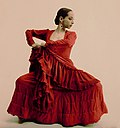 Belen maya
 -
 EMILIO BEAUCHY, Café cantante, hacia 1885, copia a la albúmina
 -
 Reima Nikkinen 1971
 -
 Palos flamencos
 -
 E Phrygian Scale
 -
 Flamenco Compas
 -
 Tablao Cordobés 06
 -
 Deborah Greenfield
 -
Castelucho
-
 Theatre Flamenco Work Sample
 -
Baile andaluz 1893 José Villegas Cordero
-
Sargent John Singer Spanish Dancer


