Prince: Difference between revisions
CSV import |
CSV import |
||
| Line 1: | Line 1: | ||
== Prince == | |||
A '''prince''' is a male ruler or member of a monarch's or former monarch's family. [[Princess]] is the female equivalent. The term has been used in various contexts throughout history and across different cultures, often signifying a person of high rank or noble birth. | |||
== | == Etymology == | ||
The word "prince" is derived from the Latin word "princeps," meaning "first" or "chief." It was used in the Roman Empire to denote the leading citizen or the first among equals. | |||
== Historical Context == | |||
== | === European Nobility === | ||
In European [[nobility]], a prince is typically a member of a royal family, especially the son of a king or queen. Princes often hold titles such as [[Duke]], [[Count]], or [[Marquess]], depending on the specific traditions of their country. | |||
[[File:Grandconde.jpg|thumb|right|Portrait of a European prince]] | |||
=== Non-European Contexts === | |||
In non-European contexts, the title of prince can have different meanings. For example, in some [[African]] and [[Asian]] cultures, a prince may be a local ruler or a member of a ruling family. | |||
== Roles and Responsibilities == | |||
Princes often have ceremonial duties and may act as representatives of the monarchy. In some cases, they may also have political or military responsibilities. | |||
=== Heir Apparent === | |||
The term "heir apparent" refers to a prince who is first in line to the throne and whose claim cannot be set aside by the birth of another heir. | |||
[[File:D._José,_Príncipe_da_Beira_e_do_Brasil.jpg|thumb|left|A prince as heir apparent]] | |||
== Titles and Styles == | |||
Princes may hold various titles and styles, which can vary significantly between different cultures and historical periods. Common styles include "His Royal Highness" or "His Serene Highness." | |||
== Heraldry == | |||
Princes often have their own [[coat of arms]], which symbolizes their family heritage and status. | |||
[[File:Coat_of_arms_of_Andorra.svg|thumb|right|Coat of arms associated with a prince]] | |||
== Modern Usage == | |||
In modern times, the role of princes has evolved, with many taking on charitable and diplomatic roles. Some princes are involved in business or cultural activities. | |||
== Related Pages == | |||
* [[Princess]] | |||
* [[Monarchy]] | |||
* [[Nobility]] | |||
* [[Heir apparent]] | |||
== Gallery == | |||
<gallery> | <gallery> | ||
File: | File:Staatswappen-Liechtensteins.svg|Coat of arms of a princely state | ||
File:Great_coat_of_arms_of_the_house_of_Grimaldi.svg|Coat of arms of the House of Grimaldi | |||
File:Coat_of_Arms_of_Otto_von_Bismarck.svg|Coat of arms associated with nobility | |||
File: | File:Duke_of_Wellington_Arms.svg|Arms of a noble family | ||
File:Herb_Pogon_Litewska.jpg|Heraldic symbol | |||
File: | |||
File: | |||
File: | |||
</gallery> | </gallery> | ||
[[Category:Royal titles]] | |||
[[Category:Nobility]] | |||
Latest revision as of 14:12, 21 February 2025
Prince[edit]
A prince is a male ruler or member of a monarch's or former monarch's family. Princess is the female equivalent. The term has been used in various contexts throughout history and across different cultures, often signifying a person of high rank or noble birth.
Etymology[edit]
The word "prince" is derived from the Latin word "princeps," meaning "first" or "chief." It was used in the Roman Empire to denote the leading citizen or the first among equals.
Historical Context[edit]
European Nobility[edit]
In European nobility, a prince is typically a member of a royal family, especially the son of a king or queen. Princes often hold titles such as Duke, Count, or Marquess, depending on the specific traditions of their country.

Non-European Contexts[edit]
In non-European contexts, the title of prince can have different meanings. For example, in some African and Asian cultures, a prince may be a local ruler or a member of a ruling family.
Roles and Responsibilities[edit]
Princes often have ceremonial duties and may act as representatives of the monarchy. In some cases, they may also have political or military responsibilities.
Heir Apparent[edit]
The term "heir apparent" refers to a prince who is first in line to the throne and whose claim cannot be set aside by the birth of another heir.

Titles and Styles[edit]
Princes may hold various titles and styles, which can vary significantly between different cultures and historical periods. Common styles include "His Royal Highness" or "His Serene Highness."
Heraldry[edit]
Princes often have their own coat of arms, which symbolizes their family heritage and status.

Modern Usage[edit]
In modern times, the role of princes has evolved, with many taking on charitable and diplomatic roles. Some princes are involved in business or cultural activities.
Related Pages[edit]
Gallery[edit]
-
 Coat of arms of a princely state
 -
 Coat of arms of the House of Grimaldi
 -
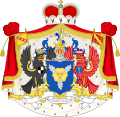 Coat of arms associated with nobility
 -
 Arms of a noble family
 -
 Heraldic symbol


