Stone pine: Difference between revisions
CSV import |
CSV import |
||
| Line 34: | Line 34: | ||
[[Category:Trees of Mediterranean climate]] | [[Category:Trees of Mediterranean climate]] | ||
[[Category:Edible nuts and seeds]] | [[Category:Edible nuts and seeds]] | ||
<gallery> | |||
File:Pinus_pinea_Wellington_Botanic_Gardens.jpg|Stone pine | |||
File:Umbrella_Pine.jpg|Umbrella Pine | |||
File:Pinus_piena_near_Pisa,_Italy.jpg|Stone pine | |||
File:Pinus_pinea_-_cone_-_Flickr_-_S._Rae.jpg|Stone pine cone | |||
File:Pinus_pinea_Doñana_1.jpg|Stone pine | |||
File:Appia_Antica_way.jpg|Stone pine | |||
File:Pinus_pinea_foliage.jpg|Stone pine foliage | |||
File:Pinus_Pinea_juvenile.JPG|Stone pine juvenile | |||
File:Pinuspinea.jpg|Stone pine | |||
File:Pinus_pinea_Bayonne.jpg|Stone pine | |||
File:Appia_antica_2-7-05_048.jpg|Stone pine | |||
File:Pines_-_Villa_Borghese_-_Rome,_Italy_-_DSC04555.jpg|Stone pine | |||
File:0_Pin_remarquable_de_la_villa_Médicis_à_Rome_(1).JPG|Stone pine | |||
</gallery> | |||
Latest revision as of 21:40, 20 February 2025
An overview of the Stone Pine tree and its uses
Overview[edit]
The Stone Pine (Pinus pinea), also known as the Italian Stone Pine, Umbrella Pine, or Parasol Pine, is a species of pine native to the Mediterranean region. It is renowned for its distinctive umbrella-like canopy and its edible seeds, commonly known as pine nuts.
Description[edit]
The Stone Pine is a medium-sized tree that typically grows to a height of 12–20 meters, although it can occasionally reach up to 25 meters. The tree is characterized by its broad, flat-topped crown, which resembles an umbrella, hence its common name. The bark is thick, reddish-brown, and deeply fissured.
The leaves of the Stone Pine are needle-like, arranged in pairs, and measure about 10–20 cm in length. The cones are ovoid, measuring 8–15 cm in length, and take about 36 months to mature. When mature, the cones release the seeds, which are the edible pine nuts.
Habitat and Distribution[edit]
Stone Pines are native to the coastal areas of the Mediterranean Basin, including Portugal, Spain, France, Italy, and Greece. They thrive in sandy, well-drained soils and are often found in coastal dunes and rocky hillsides. The tree is well adapted to the Mediterranean climate, characterized by hot, dry summers and mild, wet winters.
Uses[edit]
Culinary[edit]
The seeds of the Stone Pine, known as pine nuts, are a popular ingredient in Mediterranean cuisine. They are used in a variety of dishes, including pesto, salads, and baked goods. Pine nuts are valued for their rich, buttery flavor and high nutritional content, being a good source of protein, healthy fats, and essential minerals.
Ornamental[edit]
Due to its distinctive shape and aesthetic appeal, the Stone Pine is widely planted as an ornamental tree in parks and gardens. It is also used in landscaping for its ability to provide shade and its resistance to drought and poor soil conditions.
Ecological[edit]
Stone Pines play an important role in their native ecosystems. They provide habitat and food for various wildlife species, including birds and small mammals. The trees also help stabilize sandy soils and prevent erosion in coastal areas.
Cultivation[edit]
Stone Pines are relatively easy to cultivate, provided they are planted in well-drained soil and receive full sunlight. They are tolerant of drought and can withstand poor soil conditions, making them suitable for xeriscaping. However, they are sensitive to frost and should be protected from cold temperatures.
Related pages[edit]
-
 Stone pine
 -
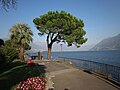 Umbrella Pine
 -
 Stone pine
 -
 Stone pine cone
 -
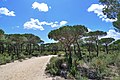 Stone pine
 -
 Stone pine
 -
 Stone pine foliage
 -
 Stone pine juvenile
 -
 Stone pine
 -
 Stone pine
 -
 Stone pine
 -
 Stone pine
 -
Stone pine


.JPG)