Hawker centre: Difference between revisions
CSV import Tags: mobile edit mobile web edit |
CSV import |
||
| Line 28: | Line 28: | ||
{{Asia-stub}} | {{Asia-stub}} | ||
{{food-stub}} | {{food-stub}} | ||
<gallery> | |||
File:Bentayan_Hawker_Centre.jpg|Bentayan Hawker Centre | |||
File:Hawker_Center,_Singapore.jpg|Hawker Center, Singapore | |||
File:09_Sentra_Wisata_Kuliner_Terminal_Manukan.jpg|Hawker centre | |||
</gallery> | |||
Latest revision as of 21:39, 20 February 2025
Hawker centre is a type of food court commonly found in Singapore, Malaysia, and other parts of Asia. These centres offer a wide variety of inexpensive local food from independent vendors, or "hawkers".
History[edit]
The concept of the hawker centre originated in the mid-20th century in Singapore and Malaysia as a means to regulate street food vendors, or hawkers. The government relocated these vendors into designated food centres to improve sanitation standards and control food preparation. This move also helped to reduce traffic congestion caused by the informal nature of street vending.
Features[edit]
Hawker centres are typically large, open-air complexes that house numerous individual food stalls. Each stall specializes in one or a few types of dishes, which can range from traditional Asian fare like Hainanese chicken rice, char kway teow, and laksa, to Western dishes such as pasta and burgers.
Unlike restaurants, hawker centres do not provide table service. Customers order and collect their food from their chosen stalls and pay immediately. Seating is communal, with tables and chairs spread throughout the centre for customers to use freely.
Cultural Significance[edit]
Hawker centres are a significant part of the culinary and cultural landscape in Singapore and Malaysia. They serve as social gathering places where people of all ages and backgrounds come together to eat, drink, and socialize.
In 2020, Singapore's hawker culture was added to the UNESCO Representative List of the Intangible Cultural Heritage of Humanity, highlighting its importance to the country's cultural identity.
Challenges and Future[edit]
Despite their popularity, hawker centres face several challenges. These include the aging hawker population, the physical demands of the job, and the difficulty in attracting younger generations to the trade.
Efforts are being made to preserve and evolve the hawker centre tradition. These include government initiatives to support aspiring hawkers, the introduction of modern technology to improve operations, and the organization of food festivals to celebrate and promote hawker food.

-
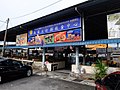 Bentayan Hawker Centre
 -
 Hawker Center, Singapore
 -
Hawker centre


