Beefsteak tomato: Difference between revisions
CSV import |
CSV import |
||
| Line 26: | Line 26: | ||
[[Category:Crops originating from the Americas]] | [[Category:Crops originating from the Americas]] | ||
{{food-stub}} | {{food-stub}} | ||
<gallery> | |||
File:Diversité_taille_tomates.jpg|Beefsteak tomato | |||
File:CoeurDeBoeuf_Tomato.JPG|Beefsteak tomato | |||
File:Cuor_di_bue_3in1.jpg|Beefsteak tomato | |||
File:Coeur_de_boeuf_vraie.JPG|Beefsteak tomato | |||
</gallery> | |||
Latest revision as of 21:39, 20 February 2025
Beefsteak Tomato is a variety of tomato that is known for its large size and meaty texture. It is one of the largest varieties of cultivated tomatoes, often weighing one pound or more.
History[edit]
The beefsteak tomato originated in the United States and has been grown there since at least the 19th century. It is named for its size and hearty texture, which are reminiscent of a beef steak.
Characteristics[edit]
Beefsteak tomatoes are typically bright red, although there are also yellow and pink varieties. They have a classic tomato flavor that is both sweet and tangy. The interior of the tomato is meaty and contains fewer seeds than many other tomato varieties. This makes beefsteak tomatoes particularly well-suited for slicing and eating raw.
Cultivation[edit]
Beefsteak tomatoes are indeterminate plants, meaning they continue to grow and produce fruit throughout the growing season until killed by frost. They require a long growing season and do well in warm climates. Beefsteak tomatoes are typically grown from seed and require staking or caging to support their large fruits.
Uses[edit]
Due to their large size and meaty texture, beefsteak tomatoes are often used in sandwiches and salads. They are also commonly used for slicing and eating raw. In addition, beefsteak tomatoes can be used in cooking and are often included in recipes for sauces, soups, and stews.
Varieties[edit]
There are several varieties of beefsteak tomatoes, including the 'Big Beef', 'Supersteak', 'Beefmaster', and 'Delicious'. Each variety has its own unique characteristics, but all are known for their large size and meaty texture.
See Also[edit]

-
 Beefsteak tomato
 -
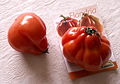 Beefsteak tomato
 -
 Beefsteak tomato
 -
Beefsteak tomato


