Atlantic surf clam: Difference between revisions
CSV import |
CSV import |
||
| Line 27: | Line 27: | ||
{{Bivalve-stub}} | {{Bivalve-stub}} | ||
{{food-stub}} | {{food-stub}} | ||
<gallery> | |||
File:Spisula_solidissima_shell.jpg|Spisula solidissima shell | |||
File:FMIB_51185_Beach_Clam_or_Hen_Clam,_Spisula_solidissima.jpeg|Beach Clam or Hen Clam, Spisula solidissima | |||
File:Fish0672_-_Flickr_-_NOAA_Photo_Library.jpg|Atlantic surf clam | |||
File:Spisula_solidissima_juv.jpg|Spisula solidissima juvenile | |||
File:Atlantic_surf_clam,_capture_production,_thousand_tonnes,_1950-2022.svg|Atlantic surf clam capture production, thousand tonnes, 1950-2022 | |||
</gallery> | |||
Latest revision as of 21:35, 20 February 2025
Atlantic Surf Clam (Spisula solidissima), also known as the Bar Clam, Skimmer, or simply Surf Clam, is a very large, edible, saltwater clam, a marine bivalve mollusk in the family Mactridae. This species is native to the Atlantic Ocean coast of North America, ranging from North Carolina to the Gulf of St. Lawrence.
Description[edit]
The Atlantic Surf Clam is one of the largest bivalves in the world, reaching up to 20 cm in length and weighing up to 1.5 kg. The shell is thick and heavy, with a color ranging from white to grayish. The interior of the shell is white, often with a purple patch near the hinge.
Habitat and Distribution[edit]
The Atlantic Surf Clam inhabits the Atlantic coast of North America, from North Carolina to the Gulf of St. Lawrence. It is typically found in sandy or muddy substrates, from the intertidal zone to depths of up to 50 meters.
Diet[edit]
The diet of the Atlantic Surf Clam consists mainly of plankton, which it filters from the water using its gills.
Commercial Use[edit]
The Atlantic Surf Clam is commercially harvested, primarily for use in chowders, bisques, and other seafood dishes. It is also used as bait in commercial and recreational fisheries.
Conservation Status[edit]
The Atlantic Surf Clam is not currently listed as threatened or endangered. However, overfishing and habitat degradation pose potential threats to its populations.
See Also[edit]


-
 Spisula solidissima shell
 -
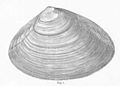 Beach Clam or Hen Clam, Spisula solidissima
 -
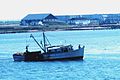 Atlantic surf clam
 -
 Spisula solidissima juvenile
 -
 Atlantic surf clam capture production, thousand tonnes, 1950-2022


