Rhombic lip: Difference between revisions
CSV import |
CSV import |
||
| Line 31: | Line 31: | ||
{{stub}} | {{stub}} | ||
<gallery> | |||
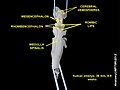
File:Human_embryo_8_weeks_8.JPG|Human embryo 8 weeks | |||
</gallery> | |||
Latest revision as of 21:34, 20 February 2025
Rhombic lip is a structure in the developing brain that contributes to the formation of the cerebellum. It is a proliferative region that gives rise to various cell types, including granule cells, unipolar brush cells, and cerebellar nuclei neurons.
Etymology[edit]
The term "rhombic lip" is derived from the Greek word "rhombos", meaning "rhombus", due to the shape of the structure in cross-section. The "lip" refers to the edge or border of the structure.
Development[edit]
The rhombic lip is formed during the early stages of embryonic development. It arises from the neuroepithelium, a layer of cells that gives rise to the nervous system. The rhombic lip is located at the dorsal edge of the hindbrain, adjacent to the fourth ventricle.
The cells of the rhombic lip undergo proliferation and differentiation to form various cell types. These cells migrate to different regions of the cerebellum, contributing to its formation and function.
Function[edit]
The rhombic lip plays a crucial role in the development of the cerebellum. It gives rise to granule cells, the most abundant cell type in the cerebellum. These cells play a key role in the processing of sensory and motor information.
The rhombic lip also produces unipolar brush cells, which are involved in the modulation of synaptic transmission in the cerebellum. In addition, it generates cerebellar nuclei neurons, which are important for motor coordination and learning.
Related Terms[edit]
See Also[edit]
 |
 |
-
 Human embryo 8 weeks


