Bath Oliver: Difference between revisions
CSV import |
CSV import |
||
| Line 48: | Line 48: | ||
[[Category:Bath, Somerset]] | [[Category:Bath, Somerset]] | ||
[[Category:English inventions]] | [[Category:English inventions]] | ||
<gallery> | |||
File:BathOliver_OnSlateWCheese.jpg|Bath Oliver on Slate with Cheese | |||
File:DrWilliamOliverdetail.jpg|Dr William Oliver detail | |||
</gallery> | |||
Latest revision as of 21:34, 20 February 2025
| [[File:|frameless|alt=]] | |
| Alternative names | |
| Type | Biscuit |
| Course | |
| Place of origin | England |
| Region or state | Bath |
| Associated national cuisine | |
| Created by | Dr. William Oliver |
| Invented | |
| Cooking time | minutes to minutes |
| Serving temperature | |
| Main ingredients | Flour, butter, milk, yeast |
| Ingredients generally used | |
| Variations | |
| Food energy | kcal |
| Nutritional value | Protein: g, Fat: g, Carbohydrate: g |
| Glycemic index | |
| Similar dishes | |
| Other information | |
| Website | [ Official website] |
Bath Oliver is a type of biscuit that originated in England, specifically in the city of Bath. It is known for its crisp texture and simple, yet distinctive flavor. The biscuit was invented by Dr. William Oliver, a physician from Bath, in the 18th century.
History[edit]
The Bath Oliver biscuit was created by Dr. William Oliver in 1750. Dr. Oliver was a physician who practiced in Bath, a city renowned for its spas and as a fashionable resort during the Georgian era. He developed the biscuit as a healthful food for his patients, particularly those who were visiting Bath for its healing waters.
Upon his death in 1764, Dr. Oliver bequeathed the recipe for the biscuit to his coachman, Mr. Atkins, along with £100 and ten sacks of flour. Mr. Atkins subsequently began commercial production of the biscuits, which quickly gained popularity.
Ingredients and Preparation[edit]
The traditional Bath Oliver biscuit is made from a simple dough consisting of:
The dough is rolled out thinly and cut into rounds before being baked until crisp. The use of yeast in the dough gives the biscuit a light texture, while the butter provides a rich flavor.
Culinary Uses[edit]
Bath Oliver biscuits are often enjoyed as a snack on their own or served with cheese. They are particularly popular as an accompaniment to blue cheese and other strong-flavored cheeses, as their mild flavor complements the cheese without overpowering it.
Cultural Significance[edit]
The Bath Oliver biscuit has become a symbol of the city of Bath and is associated with the city's history as a center for health and wellness. The biscuit's invention by a physician underscores its origins as a healthful food, although today it is enjoyed primarily for its taste.
Modern Production[edit]
Today, Bath Oliver biscuits are produced by several manufacturers, although the original recipe remains largely unchanged. They are available in supermarkets and specialty food stores throughout the UK and are sometimes exported to other countries.
See Also[edit]

-
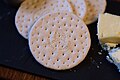 Bath Oliver on Slate with Cheese
 -
 Dr William Oliver detail


