Meze: Difference between revisions
CSV import Tags: mobile edit mobile web edit |
CSV import |
||
| Line 28: | Line 28: | ||
{{food-stub}} | {{food-stub}} | ||
{{medicine-stub}} | {{medicine-stub}} | ||
<gallery> | |||
File:Petra_metzes.jpg|Petra metzes | |||
File:Meze_Lido_Restaurant_Adalar.JPG|Meze Lido Restaurant Adalar | |||
File:Meze.jpg|Meze | |||
File:Nje_pjate_meze.jpg|Nje pjate meze | |||
File:Tzatziki_Greek_meze_or_appetizer,_also_used_as_a_sauce.jpg|Tzatziki Greek meze or appetizer, also used as a sauce | |||
File:Albanian_liver.jpg|Albanian liver | |||
File:Baba_Ghanoush.jpg|Baba Ghanoush | |||
File:Su_Böreği.JPG|Su Böreği | |||
File:Yarpaq_dolması.jpg|Yarpaq dolması | |||
File:Falafel.JPG|Falafel | |||
File:Pilaki.jpg|Pilaki | |||
File:Fattoush_mixed-salad.jpg|Fattoush mixed salad | |||
</gallery> | |||
Latest revision as of 21:31, 20 February 2025
Meze or mezze is a selection of small dishes served to accompany alcoholic drinks as a course or as appetizers before the main dish in the Near East, the Balkans, Greece, and North Africa. The term is found in all the cuisines of the former Ottoman Empire and comes from the Turkish word meze meaning "taste, flavor, snack, relish".
Etymology[edit]
The word meze comes from the Turkish word meze which means "taste, flavor, snack, relish". The word has been borrowed into Greek, Bulgarian, Romanian, and Serbian languages.
History[edit]
The tradition of meze is believed to have originated in the Persian Empire where the royal kitchens would serve a variety of small dishes to the royals before meals. This tradition was later adopted by the Ottoman Empire and spread to various parts of the world.
Types of Meze[edit]
There are many types of meze. They can be categorized into vegetarian meze, meat meze, seafood meze, and dairy meze. Some common types of meze include hummus, baba ghanoush, falafel, tabbouleh, dolma, and tzatziki.
Serving[edit]
Meze is usually served in small plates and bowls. It is often accompanied by pita bread or other types of bread. In some cultures, meze is served with raki, an anise-flavored liquor.
Health Benefits[edit]
Meze dishes are often made with fresh, healthy ingredients like vegetables, legumes, and lean meats. They are typically low in fat and high in fiber, making them a good choice for a healthy diet.
See Also[edit]


-
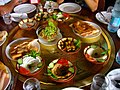 Petra metzes
 -
 Meze Lido Restaurant Adalar
 -
 Meze
Meze -
 Nje pjate meze
 -
 Tzatziki Greek meze or appetizer, also used as a sauce
 -
 Albanian liver
 -
 Baba Ghanoush
 -
 Su Böreği
 -
 Yarpaq dolması
 -
 Falafel
 -
 Pilaki
 -
 Fattoush mixed salad


