Santa Claus melon: Difference between revisions
CSV import |
CSV import |
||
| Line 29: | Line 29: | ||
[[Category:Cucurbitaceae]] | [[Category:Cucurbitaceae]] | ||
{{fruit-stub}} | {{fruit-stub}} | ||
<gallery caption="Santa_Claus_melon"> | |||
File:Piel_De_Sapo_Melon.jpg|Piel De Sapo Melon | |||
File:Puesto_de_venta_de_melones.jpg|Puesto de venta de melones | |||
</gallery> | |||
Latest revision as of 21:24, 20 February 2025
Santa Claus Melon
The Santa Claus Melon, also known as Christmas Melon or Piel de Sapo, is a variety of melon (Cucumis melo) that is primarily grown in Spain, but can also be found in other parts of the world. It is named for its long shelf life, which allows it to be eaten around Christmas time, hence the name "Santa Claus" or "Christmas" melon.
Description[edit]
The Santa Claus Melon is typically oval in shape and has a thick, green-striped outer rind. The inner flesh is pale green to white in color and is known for its sweet, succulent taste. The melon can weigh up to 6 pounds and measures up to a foot in length.
Cultivation[edit]
The Santa Claus Melon is a warm-season fruit that requires a long growing season. It is typically planted in the spring and harvested in the late summer or early fall. The melon prefers well-drained, sandy or loamy soil and requires full sun exposure.
Nutritional Value[edit]
The Santa Claus Melon is low in calories and high in Vitamin C and Vitamin A. It also contains significant amounts of Potassium and Dietary fiber.
Culinary Uses[edit]
The Santa Claus Melon is often eaten fresh, but can also be used in salads, desserts, and beverages. It pairs well with prosciutto, similar to its cousin, the Cantaloupe.
See Also[edit]
- Santa_Claus_melon
-
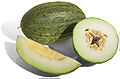 Piel De Sapo Melon
 -
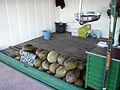 Puesto de venta de melones


