Senegalia pennata: Difference between revisions
CSV import |
CSV import |
||
| Line 38: | Line 38: | ||
* [https://www.gbif.org/species/2968478 Global Biodiversity Information Facility: Senegalia pennata] | * [https://www.gbif.org/species/2968478 Global Biodiversity Information Facility: Senegalia pennata] | ||
{{dictionary-stub1}} | {{dictionary-stub1}} | ||
== Senegalia pennata == | |||
<gallery> | |||
File:Acacia_pennata_leaves_in_Talakona_forest,_AP_W_IMG_8291.jpg|Acacia pennata leaves in Talakona forest | |||
File:Cha-om_omelette_1532_(2).JPG|Cha-om omelette | |||
File:Nam_phrik_kapi_02.jpg|Nam phrik kapi | |||
</gallery> | |||
Latest revision as of 21:23, 20 February 2025
Senegalia pennata[edit]
Senegalia pennata, also known as Climbing Wattle, is a species of plant in the family Fabaceae. It is native to South and Southeast Asia, where it is commonly used in traditional cuisine and medicine.
Description[edit]
Senegalia pennata is a climbing, perennial shrub that can reach up to 5 meters in height. It has thorny stems and feathery leaves, with small, yellow flowers that bloom in clusters. The plant's seeds are contained in long, flat pods.
Distribution and Habitat[edit]
Senegalia pennata is native to South Asia and Southeast Asia, including countries such as India, Thailand, Laos, and Cambodia. It grows in a variety of habitats, from forests to grasslands, and is often found near rivers and streams.
Uses[edit]
In traditional Asian cuisine, the young leaves and shoots of Senegalia pennata are often used as a vegetable. They are typically boiled or steamed and served with a spicy sauce. The plant is also used in traditional medicine, with various parts of the plant used to treat conditions such as fever, diarrhea, and skin diseases.
Cultivation[edit]
Senegalia pennata is a hardy plant that can grow in a variety of soil types, although it prefers well-drained soil. It is a fast-growing plant that can be propagated from seeds or cuttings. The plant requires regular pruning to control its growth and to encourage the production of new shoots.
Conservation Status[edit]
While Senegalia pennata is not currently listed as threatened or endangered, its habitat is being lost due to deforestation and urbanization. Efforts are being made to conserve the species and its habitat, including the establishment of protected areas and the promotion of sustainable harvesting practices.
See Also[edit]
References[edit]
<references />
External Links[edit]

Senegalia pennata[edit]
-
 Acacia pennata leaves in Talakona forest
 -
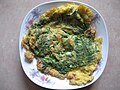 Cha-om omelette
 -
 Nam phrik kapi


