Axillary lymphadenopathy: Difference between revisions
CSV import Tags: mobile edit mobile web edit |
CSV import |
||
| Line 39: | Line 39: | ||
[[Category:Diseases and disorders]] | [[Category:Diseases and disorders]] | ||
{{medicine-stub}} | {{medicine-stub}} | ||
== Axillary_lymphadenopathy == | |||
<gallery> | |||
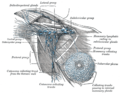
File:Gray607.png|Axillary_lymphadenopathy | |||
</gallery> | |||
Revision as of 21:23, 20 February 2025
Axillary Lymphadenopathy refers to the enlargement of the lymph nodes in the axilla (armpit) region. This condition can be a sign of various underlying health issues, ranging from benign infections to more serious conditions such as cancer. Understanding the causes, symptoms, diagnosis, and treatment of axillary lymphadenopathy is crucial for effective management and care.
Causes
Axillary lymphadenopathy can be caused by a variety of factors, including:
- Infections: Bacterial or viral infections, such as cat scratch disease or infectious mononucleosis, can lead to the enlargement of axillary lymph nodes.
- Immunization: Vaccines, especially those administered in the arm, can cause temporary lymph node enlargement as part of the immune response.
- Cancer: Malignancies such as breast cancer, lymphoma, or leukemia can present with axillary lymphadenopathy as a symptom.
- Autoimmune diseases: Conditions like rheumatoid arthritis or systemic lupus erythematosus (SLE) can cause lymph node enlargement.
Symptoms
The primary symptom of axillary lymphadenopathy is the enlargement of one or more lymph nodes in the armpit. Other symptoms may include:
- Pain or tenderness in the affected area
- Fever or night sweats, indicating an infection or malignancy
- Weight loss or fatigue, often associated with more serious conditions
Diagnosis
Diagnosis of axillary lymphadenopathy involves a combination of medical history, physical examination, and diagnostic tests, including:
- Physical examination: Palpation of the axilla to assess the size, consistency, and tenderness of the lymph nodes.
- Blood tests: To identify infections or markers of autoimmune diseases.
- Imaging tests: Ultrasound or mammography can help visualize the lymph nodes and adjacent structures.
- Biopsy: A sample of lymph node tissue may be taken for microscopic examination to determine the cause of the enlargement.
Treatment
Treatment for axillary lymphadenopathy depends on the underlying cause:
- Infections may require antibiotics or antiviral medications.
- Cancer may necessitate surgery, chemotherapy, or radiation therapy.
- Autoimmune diseases might be managed with immunosuppressive drugs.
Prevention
Preventive measures for axillary lymphadenopathy focus on the underlying causes. Maintaining good hygiene, staying up-to-date with vaccinations, and regular health check-ups can help prevent infections and detect conditions like cancer early.
See Also

Axillary_lymphadenopathy
-
 Axillary_lymphadenopathy

