Sata andagi: Difference between revisions
CSV import Tags: mobile edit mobile web edit |
CSV import |
||
| Line 34: | Line 34: | ||
* [[Official Okinawa Tourism Website]] | * [[Official Okinawa Tourism Website]] | ||
{{dictionary-stub1}} | {{dictionary-stub1}} | ||
<gallery> | |||
File:Sata_andagi_001.jpg|Sata andagi | |||
File:Making_sata_andagi.jpg|Making sata andagi | |||
File:HK_TST_尖沙咀_Tsim_Sha_Tsui_梳士巴利道_Salisbury_Road_天星小輪碼頭_Star_Ferry_Pier_shop_Tai_Cheong_Bakery_沙翁_Saa_jung_July_2021_SS2_01.jpg|Sata andagi | |||
</gallery> | |||
Latest revision as of 21:22, 20 February 2025
Sata Andagi[edit]
Sata Andagi is a traditional Okinawan sweet treat, often referred to as Okinawan doughnuts. These deep-fried dough balls are a staple in Okinawan cuisine and are commonly served at festivals and special occasions.
Ingredients[edit]
The primary ingredients for Sata Andagi include flour, sugar, and eggs. Some variations may also include sweet potatoes or brown sugar to enhance the flavor.
Preparation[edit]
To prepare Sata Andagi, the ingredients are mixed together to form a dough. The dough is then rolled into small balls and deep-fried until they turn a golden brown color. The result is a sweet treat with a crispy exterior and a soft, cake-like interior.
Cultural Significance[edit]
Sata Andagi holds a significant place in Okinawan culture. It is often prepared for special occasions such as weddings, birthdays, and festivals. In addition, it is also a popular souvenir for tourists visiting Okinawa.
Variations[edit]
There are several variations of Sata Andagi. Some versions include the addition of sweet potatoes or brown sugar. There are also variations in the size and shape of the dough balls, with some being larger and others being smaller and more bite-sized.
See Also[edit]
References[edit]
External Links[edit]

-
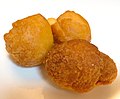 Sata andagi
 -
 Making sata andagi
 -
 Sata andagi


