Senning procedure: Difference between revisions
CSV import |
CSV import |
||
| Line 18: | Line 18: | ||
[[Category:Congenital heart defects]] | [[Category:Congenital heart defects]] | ||
{{Medicine-stub}} | {{Medicine-stub}} | ||
<gallery> | |||
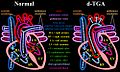
File:D-TGA.jpg|Senning procedure | |||
</gallery> | |||
Latest revision as of 21:17, 20 February 2025
Senning procedure is a surgical technique used in the treatment of congenital heart defects, specifically transposition of the great arteries (TGA). The procedure was first described by the Swedish surgeon Åke Senning in 1959.
Overview[edit]
The Senning procedure is a type of atrial switch operation, which aims to correct the blood flow in patients with TGA. In TGA, the two main arteries leaving the heart, the pulmonary artery and the aorta, are switched (transposed). This results in oxygen-rich blood being circulated back to the lungs, while oxygen-poor blood is pumped to the rest of the body. The Senning procedure redirects the blood flow at the atrial level, allowing oxygen-rich blood to reach the body and oxygen-poor blood to be sent to the lungs.
Procedure[edit]
During the Senning procedure, the surgeon creates a tunnel (or baffle) within the atrium to redirect the blood flow. The baffle is made from the patient's own atrial tissue, which reduces the risk of rejection. The procedure is complex and requires a high level of surgical skill. It is typically performed in the first few weeks of life.
Outcomes[edit]
The Senning procedure has been largely replaced by the arterial switch operation, which is thought to have better long-term outcomes. However, the Senning procedure may still be used in certain cases, such as when the patient has other heart defects that make the arterial switch operation unsuitable. Long-term follow-up is required for all patients who have undergone the Senning procedure, as complications can occur.
See also[edit]

-
 Senning procedure

