Mouna: Difference between revisions
CSV import Tags: mobile edit mobile web edit |
CSV import |
||
| Line 28: | Line 28: | ||
{{Algeria-cuisine-stub}} | {{Algeria-cuisine-stub}} | ||
{{food-stub}} | {{food-stub}} | ||
<gallery> | |||
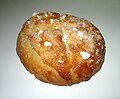
File:Mouna (brioche).jpg|Mouna | |||
</gallery> | |||
Latest revision as of 01:47, 20 February 2025
Mouna is a traditional Easter bread originating from Oran, a city in Algeria. It is a sweet, brioche-like bread, often flavored with orange blossom water and decorated with sugar. The bread is typically baked in a round shape, symbolizing the resurrection of Jesus Christ.
History[edit]
The origins of Mouna are traced back to the Spanish community in Oran, Algeria. The bread was traditionally baked during the Easter period and was often given as a gift to friends and family. The name 'Mouna' is believed to have been derived from the Spanish word 'mona', which means 'gift'.
Preparation[edit]
Mouna is made from a dough consisting of flour, sugar, eggs, and butter. The dough is often flavored with orange blossom water, giving the bread a distinctive, fragrant aroma. The dough is then shaped into a round loaf and decorated with sugar before being baked until golden brown.
Cultural Significance[edit]
Mouna is a significant part of Easter celebrations in Oran and other parts of Algeria. The bread is often shared among family and friends, symbolizing unity and togetherness. In recent years, Mouna has gained popularity in other parts of the world, particularly in France and Spain, where it is enjoyed as a festive Easter treat.
See Also[edit]
References[edit]
<references />

This article is a Algerian cuisine-related stub. You can help WikiMD by expanding it!

-
 Mouna
Mouna
.jpg)
