Pyrimethamine: Difference between revisions
CSV import |
CSV import |
||
| Line 39: | Line 39: | ||
[[Category:Pyrimidines]] | [[Category:Pyrimidines]] | ||
[[Category:Enzyme inhibitors]] | [[Category:Enzyme inhibitors]] | ||
== Pyrimethamine == | |||
<gallery> | |||
File:Pyrimethamine2DACS.svg|Pyrimethamine 2D Structure | |||
File:Pyrimethamine-from-xtal-3D-bs-17.png|Pyrimethamine 3D Structure | |||
File:Pyrimethamine traditional synthesis.png|Pyrimethamine Traditional Synthesis | |||
</gallery> | |||
Latest revision as of 01:41, 20 February 2025

Pyrimethamine is a medication used as an antiprotozoal agent. It is primarily used in the treatment and prevention of malaria and toxoplasmosis. Pyrimethamine works by inhibiting the enzyme dihydrofolate reductase, which is necessary for the synthesis of folic acid in protozoa.
Medical Uses[edit]
Pyrimethamine is commonly used in combination with a sulfonamide such as sulfadiazine to treat toxoplasmosis, an infection caused by the Toxoplasma gondii parasite. It is also used in combination with other antimalarial drugs to treat Plasmodium falciparum malaria, particularly in cases where the parasite has developed resistance to other treatments.
Malaria[edit]
Pyrimethamine is used in combination with sulfadoxine (as Fansidar) for the treatment of malaria. This combination is particularly effective against chloroquine-resistant strains of Plasmodium falciparum. It is also used as a prophylactic treatment in areas where malaria is endemic.
Toxoplasmosis[edit]
In the treatment of toxoplasmosis, pyrimethamine is often used in combination with sulfadiazine and leucovorin (folinic acid) to reduce the risk of bone marrow suppression, a common side effect of pyrimethamine.
Mechanism of Action[edit]
Pyrimethamine inhibits the enzyme dihydrofolate reductase, which is involved in the synthesis of tetrahydrofolate, a form of folic acid. This inhibition disrupts the production of nucleic acids and proteins, which are essential for the growth and replication of protozoa.
Side Effects[edit]
Common side effects of pyrimethamine include nausea, vomiting, anorexia, and allergic reactions. More severe side effects can include bone marrow suppression, which can lead to anemia, leukopenia, and thrombocytopenia. To mitigate these effects, leucovorin is often co-administered.
History[edit]
Pyrimethamine was first synthesized in the 1950s and has since become a critical drug in the treatment of protozoal infections. It is listed on the World Health Organization's List of Essential Medicines, which includes the most important medications needed in a basic health system.
See Also[edit]
References[edit]
<references group="" responsive="1"></references>
External Links[edit]


Pyrimethamine[edit]
-
 Pyrimethamine 2D Structure
 -
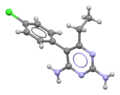 Pyrimethamine 3D Structure
 -
 Pyrimethamine Traditional Synthesis


