Sano shunt: Difference between revisions
CSV import |
CSV import |
||
| Line 26: | Line 26: | ||
[[Category:Cardiology]] | [[Category:Cardiology]] | ||
[[Category:Congenital heart disease]] | [[Category:Congenital heart disease]] | ||
<gallery> | |||
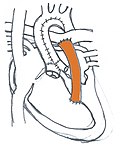
File:SanoShunt orange.jpg|Sano shunt | |||
</gallery> | |||
Latest revision as of 01:38, 20 February 2025
Sano shunt is a medical procedure used in the treatment of congenital heart disease. It is named after the Japanese surgeon who first described it, Shunji Sano.
Overview[edit]
The Sano shunt is a modification of the Norwood procedure, which is used to treat hypoplastic left heart syndrome and other similar conditions. The Sano shunt involves the placement of a conduit from the right ventricle to the pulmonary artery, allowing blood to flow directly from the heart to the lungs.
Procedure[edit]
The Sano shunt procedure is performed under general anesthesia. The surgeon makes an incision in the chest to access the heart. A tube made of synthetic material is then attached to the right ventricle and the pulmonary artery. This tube, or shunt, allows blood to bypass the underdeveloped left side of the heart and flow directly to the lungs, where it can pick up oxygen.
Risks and Complications[edit]
Like all surgeries, the Sano shunt procedure carries some risks. These include infection, bleeding, and complications from anesthesia. There is also a risk of the shunt becoming blocked or failing over time. Regular follow-up appointments with a cardiologist are necessary to monitor the function of the shunt.
Aftercare[edit]
After the Sano shunt procedure, the patient will need to take medications to prevent blood clots and to manage heart function. Regular follow-up appointments with a cardiologist are also necessary to monitor the function of the shunt and to check for any potential complications.
See Also[edit]
References[edit]
<references />
 | This medical article is a stub. You can help WikiMD by expanding the page. |
-
 Sano shunt

