Measles virus: Difference between revisions
CSV import Tags: mobile edit mobile web edit |
CSV import |
||
| Line 28: | Line 28: | ||
{{stub}} | {{stub}} | ||
{{dictionary-stub1}} | {{dictionary-stub1}} | ||
== Measles virus == | |||
<gallery> | |||
File:Measles virus.JPG|Measles virus | |||
File:Receptors MV.tif|Receptors MV | |||
File:MV genome.tif|MV genome | |||
File:Measles virion.tif|Measles virion | |||
File:MV life cycle.tif|MV life cycle | |||
File:231-Measles-virus-proteins.tif|Measles virus proteins | |||
</gallery> | |||
Latest revision as of 01:34, 20 February 2025
Measles virus is a single-stranded, negative-sense, enveloped RNA virus of the genus Morbillivirus within the family Paramyxoviridae. It is the cause of measles, a highly contagious disease in humans.
Structure[edit]
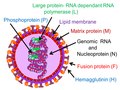
The measles virus is approximately 150 to 300 nanometers in diameter. It has a single-stranded RNA genome, which is surrounded by a lipid envelope. The envelope is studded with two types of glycoprotein spikes: hemagglutinin (H) and fusion (F) proteins.
Genome[edit]
The genome of the measles virus is approximately 16 kilobases in length. It encodes eight proteins: nucleocapsid protein (N), phosphoprotein (P), matrix protein (M), fusion protein (F), hemagglutinin (H), large protein (L), and two nonstructural proteins, C and V.
Replication[edit]
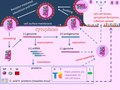
The measles virus enters the host cell by binding to the CD150 (SLAM) receptor on the cell surface. The virus then uncoats and releases its RNA genome into the cell. The viral RNA is transcribed into mRNA by the viral RNA-dependent RNA polymerase. The mRNA is then translated into viral proteins by the host cell's machinery. The newly synthesized viral proteins and RNA are assembled into new virus particles, which bud from the cell surface and are released to infect other cells.
Pathogenesis[edit]
The measles virus initially infects the respiratory tract. It then spreads to the lymphatic system and subsequently to other organs. The virus causes a characteristic rash, fever, and other symptoms of measles. Complications can include pneumonia, encephalitis, and subacute sclerosing panencephalitis (SSPE).
Prevention and control[edit]
Vaccination with the measles vaccine is the most effective way to prevent infection. The vaccine is usually given as part of the MMR (measles, mumps, rubella) or MMRV (measles, mumps, rubella, varicella) vaccine.