Midbrain: Difference between revisions
CSV import Tags: mobile edit mobile web edit |
CSV import Tags: mobile edit mobile web edit |
||
| Line 32: | Line 32: | ||
{{stub}} | {{stub}} | ||
<gallery> | |||
File:Midbrain of the Human Brainstem.svg|Midbrain of the Human Brainstem | |||
File:Location of Midbrain in inferior view.png|Location of Midbrain in inferior view | |||
File:Human brainstem-thalamus posterior view description.JPG|Human brainstem thalamus posterior view | |||
File:Gray719.png|Gray's Anatomy illustration of the midbrain | |||
File:Brain-ventricle-anatomy-diagram.jpg|Brain ventricle anatomy diagram | |||
File:Cn3nucleus-en.svg|Oculomotor nerve nucleus | |||
File:Midbrain - inferior colliculus.svg|Midbrain - inferior colliculus | |||
File:Brain Anatomy - Mid-Fore-HindBrain.png|Brain Anatomy - Midbrain, Forebrain, Hindbrain | |||
File:Human embryo 8 weeks 4.JPG|Human embryo at 8 weeks | |||
</gallery> | |||
Latest revision as of 01:30, 20 February 2025
Midbrain or mesencephalon is a portion of the central nervous system associated with vision, hearing, motor control, sleep/wake, arousal (alertness), and temperature regulation.
Structure[edit]
The midbrain is located below the cerebral cortex, and above the hindbrain placing it near the center of the brain. It is a part of the brainstem and forms a central part of the brain.
Parts of the Midbrain[edit]
The midbrain is composed of several parts:
- Tectum: The dorsal part of the midbrain, responsible for auditory and visual responses.
- Tegmentum: A part of the midbrain involved in many unconscious homeostatic and reflexive pathways.
- Cerebral peduncle: This contains the large ascending (sensory) and descending (motor) nerve tracts that run to and from the cerebrum from the pons. Mainly it connects the forebrain and the hindbrain.
- Crus cerebri: A white matter tract of the cerebral peduncle which contains the motor tract fibers.
- Substantia nigra: Literally 'black substance', it is closely associated with motor planning, learning, emotion, and addiction.
Function[edit]
The midbrain serves important functions in motor movement, particularly movements of the eye, and in auditory and visual processing. It is located within the brainstem and between the two other developmental regions of the brain, the forebrain and the hindbrain; compared with those regions, the midbrain is relatively small.
Clinical significance[edit]
Damage to the midbrain can cause a variety of motor and sensory problems, including Parkinson's disease, schizophrenia, and problems with vision and hearing. In some cases, it can also lead to coma or death.
See also[edit]
References[edit]
<references />
 | |
|---|---|
 |
 |
-
 Midbrain of the Human Brainstem
 -
 Location of Midbrain in inferior view
 -
 Human brainstem thalamus posterior view
 -
 Gray's Anatomy illustration of the midbrain
 -
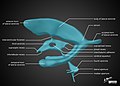 Brain ventricle anatomy diagram
 -
 Oculomotor nerve nucleus
 -
 Midbrain - inferior colliculus
 -
 Brain Anatomy - Midbrain, Forebrain, Hindbrain
 -
 Human embryo at 8 weeks


