Reinheitsgebot: Difference between revisions
CSV import |
CSV import |
||
| Line 18: | Line 18: | ||
[[Category:Beer in Germany]] | [[Category:Beer in Germany]] | ||
{{food-stub}} | {{food-stub}} | ||
<gallery> | |||
File:Freshly picked hops.jpg|Freshly picked hops | |||
File:Barley.jpg|Barley | |||
File:Reinheitsgebot München Viktualienmarkt wiki.JPG|Reinheitsgebot München Viktualienmarkt | |||
File:Muenchner Reinheitsgebot.JPG|Münchner Reinheitsgebot | |||
</gallery> | |||
Latest revision as of 01:28, 20 February 2025
Reinheitsgebot, also known as the German Beer Purity Law, is a regulation concerning the production of beer in Germany. Enacted in 1516 by Duke Wilhelm IV of Bavaria, the law originally stipulated that beer could only be brewed from three ingredients: barley, water, and hops. The omission of yeast from the list was not an oversight; the role of yeast in fermentation was not understood at the time, and it was only later acknowledged as a vital ingredient in beer production.
History[edit]
The Reinheitsgebot was introduced for several reasons: to prevent price competition with bakers for wheat and rye, to conserve cereals for use in bread, and to ensure the purity and quality of beer by banning the use of problematic additives and preservatives. This law is one of the oldest food-quality regulations in the world that is still in use, albeit in a modified form.
Over the centuries, the Reinheitsgebot has undergone several changes and adaptations. With the unification of Germany in the late 19th century, the law was challenged as it restricted the free trade among the German states. However, it was eventually incorporated into German tax law, and its principles continue to influence German beer production to this day.
Impact[edit]
The Reinheitsgebot has had a profound impact on the brewing industry in Germany and beyond. It has been credited with maintaining high standards of beer quality and purity. However, it has also been criticized for stifling innovation by restricting the types of ingredients that can be used in brewing.
In modern times, the Reinheitsgebot is no longer a legal requirement for all beers produced in Germany. However, many German brewers continue to adhere to its principles, and beers that comply with the law are often labeled as "Reinheitsgebot compliant" or similar. The law has also influenced brewing traditions in other countries, with many craft brewers around the world adopting the Reinheitsgebot principles as a mark of quality and tradition.
Contemporary Relevance[edit]
Today, the Reinheitsgebot is both celebrated and debated within the beer community. Some see it as an important tradition that guarantees the quality and purity of beer. Others argue that it limits diversity and innovation in brewing. Despite these differing views, the Reinheitsgebot remains a significant part of Germany's cultural heritage and continues to play a role in the global brewing industry.

-
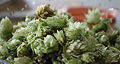 Freshly picked hops
 -
 Barley
 -
 Reinheitsgebot München Viktualienmarkt
 -
 Münchner Reinheitsgebot


