Trinity: Difference between revisions
CSV import |
CSV import |
||
| Line 50: | Line 50: | ||
{{Christianity}} | {{Christianity}} | ||
[[Category:Christian theology]] | [[Category:Christian theology]] | ||
<gallery> | |||
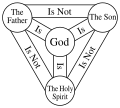
File:Shield-Trinity-Scutum-Fidei-English.svg|Shield of the Trinity | |||
File:Meister Bertram von Minden 009.jpg|Trinity by Meister Bertram von Minden | |||
File:Dogmatic sarcophagus.JPG|Dogmatic Sarcophagus | |||
File:Albrecht Dürer - Adoration of the Trinity (Landauer Altar) - Google Art Project.jpg|Adoration of the Trinity by Albrecht Dürer | |||
File:Bartolomé Esteban Murillo - The Heavenly and Earthly Trinities - 1681-82.jpg|The Heavenly and Earthly Trinities by Bartolomé Esteban Murillo | |||
File:Glória de São Nicolau - António Manuel da Fonseca (Igreja de São Nicolau, Lisboa), cropped.png|Glória de São Nicolau by António Manuel da Fonseca | |||
File:Piero, battesimo di cristo 04.jpg|Baptism of Christ by Piero | |||
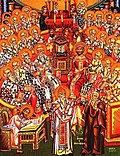
File:THE FIRST COUNCIL OF NICEA.jpg|The First Council of Nicaea | |||
File:Hierarch panagia episcopi cropped.jpg|Hierarch Panagia Episcopi | |||
File:The church of SS Peter and Paul in Brockdish - stained glass - The Holy Trinity.png|The Holy Trinity stained glass | |||
File:France Paris St-Denis Trinity-CROPPED.jpg|Trinity at St-Denis, Paris | |||
File:Llanbeblig Hours (f. 4v.) God, The Holy Spirit, and Christ Crucified.jpg|God, The Holy Spirit, and Christ Crucified | |||
</gallery> | |||
Latest revision as of 01:24, 20 February 2025
-
 Trinity
 -
 Trinity
 -
 Trinity
 -
 Trinity
 -
 Trinity
 -
 Trinity
 -
 Trinity
 -
 Trinity
 -
 Trinity
 -
 Trinity
 -
 Trinity
 -
 Trinity


_-_Google_Art_Project.jpg)

,_cropped.png)


_God,_The_Holy_Spirit,_and_Christ_Crucified.jpg)
Trinity[edit]
The term "Trinity" is most commonly associated with the Christian doctrine of the Holy Trinity, which describes the nature of God as three consubstantial persons: the Father, the Son (Jesus Christ), and the Holy Spirit. This concept is central to most branches of Christianity and is a defining characteristic of the faith.
Christian Doctrine[edit]
The doctrine of the Trinity is a theological construct that attempts to explain the complex nature of God as presented in the Bible. According to this doctrine, God is one being who exists in three distinct persons, each of whom is fully and completely God. This is often summarized in the phrase "one God in three persons."
The Father[edit]
In the Trinity, the Father is the source of the Godhead and is often associated with creation and providence. The Father is considered the first person of the Trinity and is often depicted as the creator of the universe.
The Son[edit]
The Son, Jesus Christ, is the second person of the Trinity. Christians believe that Jesus is both fully divine and fully human, having been incarnated as a man to bring salvation to humanity. The Son is associated with redemption and is central to the Christian faith due to his crucifixion and resurrection.
The Holy Spirit[edit]
The Holy Spirit is the third person of the Trinity and is often associated with the presence of God in the world today. The Holy Spirit is believed to be active in the lives of believers, guiding, comforting, and empowering them.
Historical Development[edit]
The doctrine of the Trinity was developed over several centuries and was formalized in the early ecumenical councils of the Church, such as the Council of Nicaea in 325 AD and the Council of Constantinople in 381 AD. These councils addressed various heresies and misunderstandings about the nature of God and affirmed the Trinitarian doctrine as orthodox Christian teaching.
Theological Significance[edit]
The Trinity is significant in Christian theology because it provides a framework for understanding the nature of God and the relationship between the divine persons. It emphasizes the unity and diversity within the Godhead and has implications for Christian worship, prayer, and the understanding of salvation.
Related Pages[edit]
| Part of a series on |
| Christianity |
|---|
 |

-
Shield of the Trinity
-
Trinity by Meister Bertram von Minden
-
Dogmatic Sarcophagus
-
Adoration of the Trinity by Albrecht Dürer
-
The Heavenly and Earthly Trinities by Bartolomé Esteban Murillo
-
Glória de São Nicolau by António Manuel da Fonseca
-
Baptism of Christ by Piero
-
The First Council of Nicaea
-
Hierarch Panagia Episcopi
-
The Holy Trinity stained glass
-
Trinity at St-Denis, Paris
-
God, The Holy Spirit, and Christ Crucified
