China: Difference between revisions
No edit summary |
CSV import |
||
| Line 55: | Line 55: | ||
[[Category:States and territories established in 1949]] | [[Category:States and territories established in 1949]] | ||
[[Category:Cradle of civilization]] | [[Category:Cradle of civilization]] | ||
<gallery> | |||
File:Great Hall Of The People At Night.JPG|Great Hall Of The People At Night | |||
File:Xinhuamen Gate of Zhongnanhai across Changan Street.JPG|Xinhuamen Gate of Zhongnanhai | |||
File:习近平 Xi Jinping 20221023 02.jpg|Xi Jinping | |||
File:李强 Li Qiang 20221023.jpg|Li Qiang | |||
File:赵乐际 Zhao Leji 20221023.jpg|Zhao Leji | |||
File:王沪宁 Wang Huning 20221023.jpg|Wang Huning | |||
</gallery> | |||
Latest revision as of 01:22, 20 February 2025
The People's Republic of China (PRC), commonly known as China, is a country located in Asia, specifically in the eastern part of the continent. With a vast landmass and a history spanning thousands of years, China has emerged as one of the world's major economic and political powers. This article will provide an overview of China with a particular emphasis on its healthcare system.
Geography and Demographics[edit]
China is the world's third-largest country by area and boasts the largest population, with over 1.4 billion inhabitants. The nation encompasses diverse landscapes, from the expansive deserts in the west to the fertile plains in the east.
History[edit]
China has a rich history that dates back millennia. Over the centuries, the country has seen the rise and fall of various dynasties, each leaving its mark on the nation's culture, architecture, and traditions.
Economy[edit]
China's economy has witnessed rapid growth in recent decades, transforming it from a primarily agrarian society to an industrial powerhouse. As of the 21st century, it stands as the world's second-largest economy by nominal GDP.
Healthcare in China[edit]
Overview[edit]
China's healthcare system has undergone significant reforms in recent decades. With the aim of providing universal healthcare, the government has invested heavily in public health and medical services, though challenges remain.
Health Insurance[edit]
In the late 20th and early 21st centuries, China rolled out a series of insurance programs aiming to cover the vast majority of its citizens. These include the Urban Employee Basic Medical Insurance (UEBMI), Urban Resident Basic Medical Insurance (URBMI), and the New Cooperative Medical Scheme (NCMS) for rural residents.
Hospitals and Clinics[edit]
China's hospital system consists of public and private institutions, with public hospitals serving as the primary healthcare providers. Tiered based on their capabilities, they range from community clinics to large specialized hospitals.
Traditional Chinese Medicine[edit]
Traditional Chinese Medicine (TCM) plays a significant role in China's healthcare landscape. Integrated with modern medicine, TCM practitioners offer herbal remedies, acupuncture, and other treatments. Many hospitals have dedicated TCM departments.
Challenges[edit]
Despite advancements, China's healthcare system faces challenges, including disparities in healthcare quality between urban and rural areas, a rapidly aging population, and the rise of non-communicable diseases like diabetes and heart disease.
Future Outlook[edit]
China continues to prioritize healthcare reforms, aiming for more equitable access and improved healthcare outcomes. Efforts are being made to modernize Traditional Chinese Medicine, invest in medical research, and leverage technology for healthcare delivery.
See Also[edit]
| This article is a stub. You can help WikiMD by registering to expand it. |
-
 Great Hall Of The People At Night
 -
 Xinhuamen Gate of Zhongnanhai
 -
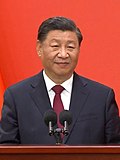 Xi Jinping
 -
 Li Qiang
 -
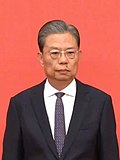 Zhao Leji
 -
 Wang Huning


- Countries
- Healthcare in Asia
- China
- People's Republic of China
- Atheist states
- BRICS nations
- Chinese-speaking countries and territories
- Communist states
- Countries in Asia
- East Asian countries
- E7 nations
- G20 nations
- Member states of the Shanghai Cooperation Organisation
- Member states of the United Nations
- Northeast Asian countries
- One-party states
- Republics
- States with limited recognition
- States and territories established in 1949
- Cradle of civilization
