Melarsomine: Difference between revisions
CSV import |
CSV import |
||
| Line 26: | Line 26: | ||
[[Category:Veterinary medicine]] | [[Category:Veterinary medicine]] | ||
{{pharmacology-stub}} | {{pharmacology-stub}} | ||
== Melarsomine == | |||
<gallery> | |||
File:melaminylthioarsenate.png|Melaminylthioarsenate | |||
File:Melarsomine 3D spacefill.png|Melarsomine 3D Spacefill | |||
</gallery> | |||
Latest revision as of 01:20, 20 February 2025
Melarsomine is a drug used in the treatment of canine heartworm disease. It is an organic compound that contains arsenic, and is marketed under the brand name Immiticide.
Chemistry[edit]
Melarsomine is an organoarsenic compound. It is a derivative of arsenamide, a class of compounds that have been used in the treatment of leishmaniasis and trypanosomiasis in humans. The chemical formula of melarsomine is C8H14As2N2O2.
Pharmacology[edit]
Melarsomine is a macrocyclic lactone that acts by disrupting the neurotransmitter gamma-aminobutyric acid (GABA) in the parasite. This causes paralysis and death of the adult heartworms. The drug is administered by deep intramuscular injection into the lumbar muscles.
Clinical use[edit]
Melarsomine is used in the treatment of canine heartworm disease. It is the only drug approved by the Food and Drug Administration (FDA) for this purpose. Treatment with melarsomine involves a series of injections that kill the adult heartworms. The dead worms are then gradually reabsorbed by the body over a period of several months.
Side effects[edit]
The most common side effects of melarsomine are pain and swelling at the injection site. Other side effects can include fever, lethargy, anorexia, and coughing. In rare cases, severe reactions including pulmonary thromboembolism can occur.
See also[edit]
References[edit]
<references />

Melarsomine[edit]
-
 Melaminylthioarsenate
 -
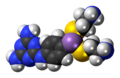 Melarsomine 3D Spacefill


