Health effects of radon: Difference between revisions
CSV import Tags: mobile edit mobile web edit |
CSV import |
||
| Line 32: | Line 32: | ||
{{medicine-stub}} | {{medicine-stub}} | ||
<gallery> | |||
File:Lead210inairatjapan.png|Lead 210 in air at Japan | |||
File:Radon Concentration next to Uranium Mine.PNG|Radon Concentration next to Uranium Mine | |||
File:Radon Lognormal distribution.gif|Radon Lognormal distribution | |||
File:WLM-Cancer risk.jpg|WLM Cancer risk | |||
File:Average-radiation.png|Average radiation | |||
File:Radon and Cancer by Cohen.GIF|Radon and Cancer by Cohen | |||
File:Radon test kit.jpg|Radon test kit | |||
</gallery> | |||
Latest revision as of 01:15, 20 February 2025
Health Effects of Radon
Radon is a naturally occurring radioactive gas that has become a significant concern due to its health effects on humans. This colorless, odorless gas originates from the decay of uranium in soil, rock, and water, and can accumulate in buildings, especially in confined areas such as basements and ground floors. Understanding the health risks associated with radon exposure is crucial for public health and safety.
Sources and Exposure[edit]
Radon gas is produced from the natural radioactive decay of uranium, which is found in varying amounts in the soil and rock beneath homes, in well water, and in building materials. The primary route of radon exposure is inhalation of air containing radon. This can occur in any type of building, including homes, offices, and schools, leading to indoor radon levels that vary depending on the building's construction, ventilation, and the underlying geology.
Health Risks[edit]
The primary health risk from radon exposure is an increased risk of developing lung cancer. Radon decay products can attach to lung tissue when inhaled, damaging the DNA and potentially leading to cancer. The risk of lung cancer increases with the level of radon and the length of exposure. The United States Environmental Protection Agency (EPA) and the World Health Organization (WHO) have classified radon as a carcinogen, specifically noting that it is the second leading cause of lung cancer in the United States after cigarette smoking.
Lung Cancer[edit]
The link between radon exposure and lung cancer has been established through numerous studies worldwide. Both smokers and nonsmokers are at risk, but smokers who are exposed to high levels of radon have a significantly higher risk of developing lung cancer. Children may also be at a higher risk due to their higher respiratory rates and rapidly dividing cells.
Testing and Mitigation[edit]
Testing for radon is the only way to know if a home or building has high radon levels, as it cannot be detected by sight, smell, or taste. Radon testing kits are available for purchase, and there are professionals who can perform tests, especially during real estate transactions. If high levels of radon are found, mitigation measures can be taken to reduce radon levels. These measures may include improving the ventilation of the building, sealing cracks in floors and walls, and installing radon mitigation systems that vent radon gas outside.
Prevention[edit]
Preventing radon exposure is key to reducing the health risks associated with this gas. Building new homes with radon-resistant construction techniques can prevent radon from entering. For existing homes, testing and mitigation can significantly reduce radon levels. Public awareness and education on the health risks of radon, testing, and mitigation are essential for preventing radon-related lung cancer.
Conclusion[edit]
Radon is a significant public health hazard that can lead to lung cancer if not properly addressed. Awareness, testing, and mitigation are critical steps in protecting individuals and communities from the harmful effects of radon exposure. By understanding the sources, health risks, and prevention strategies, we can reduce the impact of radon on public health.
This article is a medical stub. You can help WikiMD by expanding it!
-
 Lead 210 in air at Japan
 -
 Radon Concentration next to Uranium Mine
 -
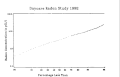 Radon Lognormal distribution
 -
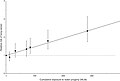 WLM Cancer risk
 -
 Average radiation
 -
 Radon and Cancer by Cohen
 -
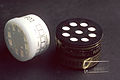 Radon test kit


