Kompyang: Difference between revisions
CSV import |
CSV import |
||
| Line 34: | Line 34: | ||
[[Category:Chinese cuisine]] | [[Category:Chinese cuisine]] | ||
[[Category:Breads]] | [[Category:Breads]] | ||
<gallery> | |||
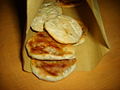
File:Jian'ou Kompyang.JPG|Kompyang | |||
</gallery> | |||
Revision as of 01:13, 20 February 2025
A traditional Indonesian bread
Kompyang, also known as kompiang or kue kompyang, is a type of bread originating from Fujian province in China and is popular in Indonesia, particularly among the Chinese Indonesian community. This bread is known for its unique texture and flavor, which is achieved through a specific baking process and the use of traditional ingredients.
History
Kompyang has its roots in the Fujian province of China, where it was originally created by the Hoklo people. The bread was brought to Indonesia by Chinese immigrants and has since become a staple in areas with significant Chinese Indonesian populations. The name "kompyang" is derived from the Hokkien language, reflecting its cultural origins.
Ingredients and Preparation
The main ingredients of kompyang include wheat flour, yeast, sugar, and salt. Some variations may include sesame seeds or pork filling, although the traditional version is typically plain.
Dough Preparation
The dough is prepared by mixing wheat flour with yeast, sugar, and salt, and then kneading it until it becomes smooth and elastic. The dough is allowed to rise until it doubles in size, which can take several hours depending on the ambient temperature.
Shaping and Baking
Once the dough has risen, it is divided into small portions and shaped into flat, round discs. These discs are then baked in a hot oven until they develop a golden-brown crust. The baking process gives kompyang its characteristic chewy texture and slightly crispy exterior.
Cultural Significance
Kompyang is more than just a type of bread; it holds cultural significance for the Chinese Indonesian community. It is often consumed during traditional festivals and family gatherings. The bread is also associated with good luck and prosperity, making it a popular choice for celebratory occasions.
Consumption
Kompyang is typically eaten as a snack or accompaniment to meals. It can be enjoyed plain or with various fillings, such as sweet or savory spreads. In some regions, it is served with tea or coffee as part of a traditional breakfast.
Variations
While the basic recipe for kompyang remains consistent, there are several regional variations that incorporate local ingredients and flavors. For example, some versions may include coconut or pandan for a distinct taste.
Related pages
-
 Kompyang

