Shark attack: Difference between revisions
No edit summary |
CSV import |
||
| Line 30: | Line 30: | ||
[[Category:Marine biology]] | [[Category:Marine biology]] | ||
[[Category:Animal attacks]] | [[Category:Animal attacks]] | ||
<gallery> | |||
File:Shark warning - Salt Rock South Africa.jpg|Shark warning sign at Salt Rock, South Africa | |||
File:Total shark attacks per year, OWID.svg|Total shark attacks per year | |||
File:Snorkeler with blacktip reef shark.jpg|Snorkeler with blacktip reef shark | |||
File:Watsonandtheshark-original.jpg|Watson and the Shark | |||
File:White shark.jpg|White shark | |||
File:Scarface-tigershark.jpg|Scarface tiger shark | |||
File:Bullshark Beqa Fiji 2007.jpg|Bull shark in Beqa, Fiji | |||
File:Coogee Beach gnangarra-215.jpg|Coogee Beach | |||
File:Protecting people from shark attacks|Protecting people from shark attacks | |||
File:Signs warning of shark attacks at Boa Viagem Beach in Recife, Brazil.jpg|Signs warning of shark attacks at Boa Viagem Beach, Recife, Brazil | |||
</gallery> | |||
Revision as of 01:11, 20 February 2025
Shark attacks refer to incidents of humans being attacked by sharks. Although relatively rare, with approximately 80 unprovoked attacks reported globally each year, the phenomenon often receives significant attention and perpetuates a widespread fear of sharks. This fear is frequently exacerbated by historic events of serial attacks, such as the Jersey Shore shark attacks of 1916, and sensationalized through horror fiction and film portrayals, like the renowned 'Jaws' series.
Frequency and Species Involved
Of the more than 489 shark species known to exist, only a fraction pose any significant threat to humans. The great white shark, tiger shark, and bull shark are the three species responsible for double-digit numbers of fatal, unprovoked attacks on humans. The oceanic whitetip shark is suspected to have caused numerous fatalities, particularly among shipwreck survivors, but these instances often go unrecorded and hence are not reflected in the official statistics.
Nature of Attacks
Shark attacks can be classified as provoked or unprovoked. Unprovoked attacks are initiated by the shark without any human provocation. Provoked attacks, on the other hand, occur when a human touches, teases, feeds, or otherwise disturbs a shark, prompting a defensive response.
Prevention and Response
There are several strategies to reduce the risk of shark attacks, such as avoiding swimming alone, staying close to shore, and refraining from entering the water if bleeding or if sharks are known to be present. Should a shark attack occur, fighting back by hitting the shark in the eyes or gills is often recommended, as these are sensitive areas. Medical attention should be sought immediately following a shark attack to manage trauma and prevent infection.
Public Perception and Conservation Efforts
Despite the rarity of shark attacks, public perception is often skewed towards viewing sharks as dangerous predators. This perception can have negative implications for shark conservation efforts, as these creatures play a critical role in maintaining marine ecosystem health. There is a growing need for education and awareness about the crucial role of sharks and the relative rarity of shark attacks to promote coexistence and conservation.
References
<references/>
See Also
 | |
|---|---|
 |
 |
-
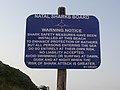 Shark warning sign at Salt Rock, South Africa
 -
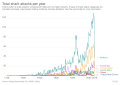 Total shark attacks per year
 -
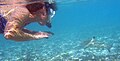 Snorkeler with blacktip reef shark
 -
 Watson and the Shark
 -
 White shark
 -
 Scarface tiger shark
 -
 Bull shark in Beqa, Fiji
 -
 Coogee Beach
 -
Protecting people from shark attacks
-
 Signs warning of shark attacks at Boa Viagem Beach, Recife, Brazil


