Ethylmorphine: Difference between revisions
CSV import |
CSV import |
||
| Line 31: | Line 31: | ||
{{stub}} | {{stub}} | ||
{{No image}} | {{No image}} | ||
== Ethylmorphine == | |||
<gallery> | |||
File:Ethylmorphine.svg|Ethylmorphine | |||
File:Ethylmorphine molecule ball.png|Ethylmorphine molecule ball | |||
</gallery> | |||
Revision as of 01:04, 20 February 2025
Ethylmorphine (also known as Codethyline) is an opioid analgesic and antitussive. It is a derivative of morphine and is chemically known as 3-ethylmorphine. Ethylmorphine is used for the treatment of moderate to severe pain and to suppress coughing, especially following surgery or injury.
Etymology
The term "Ethylmorphine" is derived from the two components of the drug: "ethyl", referring to the ethyl group in its chemical structure, and "morphine", the opioid from which it is derived.
Pharmacology
Ethylmorphine acts as a prodrug to morphine. It is metabolized in the liver by demethylation and deethylation to produce morphine, which is more potent and binds to the mu opioid receptor. This results in an analgesic effect.
Medical Uses
Ethylmorphine is used for the relief of moderate to severe pain. It can also be used as an antitussive to suppress coughing. It is often used post-surgery or for injuries where pain relief is required.
Side Effects
Like other opioids, ethylmorphine has several side effects. These can include drowsiness, dizziness, nausea, vomiting, constipation, and respiratory depression. Long-term use can lead to dependency and withdrawal symptoms.
Related Terms
See Also
 |
 |
Ethylmorphine
-
 Ethylmorphine
 -
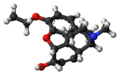 Ethylmorphine molecule ball


